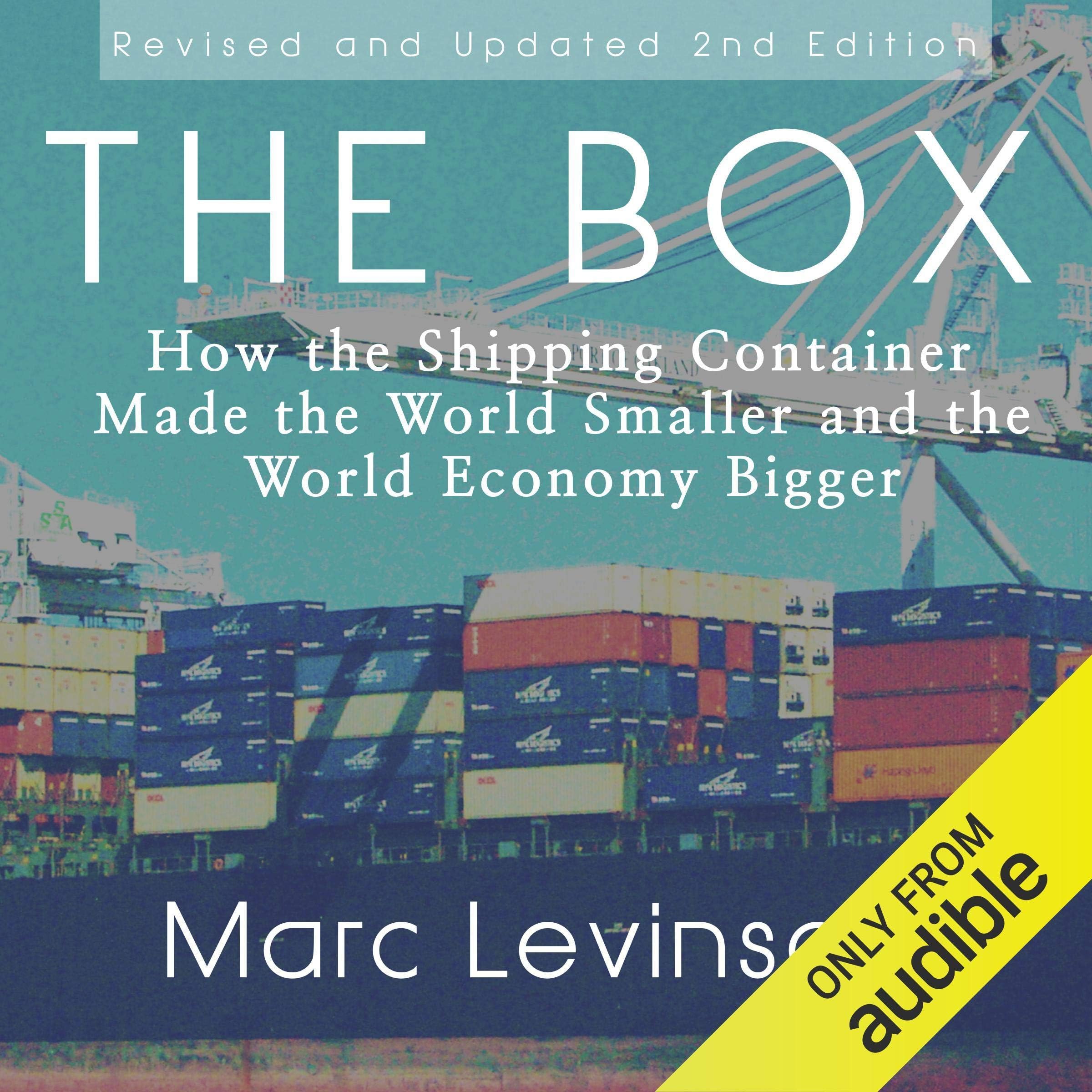
The Box: How the Shipping Container Made the World Smaller and the World Economy Bigger
Product ID: 12575675
In April 1956, a refitted oil tanker carried 58 shipping containers from Newark to Houston. From that modest beginning, container shipping developed into a huge industry that made the boom in global trade possible. The Box tells the dramatic story of the container's creation, the decade of struggle before it was widely adopted, and the sweeping economic consequences of the sharp fall in transportation costs that containerization brought about. Published on the 50th anniversary of the first container voyage, this is the first comprehensive history of the shipping container. It recounts how the drive and imagination of an iconoclastic entrepreneur, Malcom McLean, turned containerization from an impractical idea into a massive industry that slashed the cost of transporting goods around the world and made the boom in global trade possible. But the container didn't just happen. Its adoption required huge sums of money, both from private investors and from ports that aspired to be on the leading edge of a new technology. It required years of high-stakes bargaining with two of the titans of organized labor, Harry Bridges and Teddy Gleason, as well as delicate negotiations on standards that made it possible for almost any container to travel on any truck or train or ship. Ultimately, it took McLean's success in supplying U.S. forces in Vietnam to persuade the world of the container's potential. Drawing on previously neglected sources, economist Marc Levinson shows how the container transformed economic geography, devastating traditional ports such as New York and London and fueling the growth of previously obscure ones, such as Oakland. By making shipping so cheap that industry could locate factories far from its customers, the container paved the way for Asia to become the world's workshop and brought consumers a previously unimaginable variety of low-cost products from around the globe. Review: A fascinating and compelling hypothesis - Like most inhabitants of earth, I never gave much thought to intermodal shipping. It wasn't until I served as an economic development officer in southern Afghanistan and began looking into ways we could more efficiently export the high value fruits and nuts grown locally to the lucrative markets of the Middle East that I discovered "the box": the ubiquitous forty-foot container we've all seen on tractor trailer chassis, cargo ships and holding yards. On Kandahar Airfield, where I was stationed for a year, these containers were everywhere; literally thousands of them, double stacked in lines a half mile long, most serving as temporary warehouses while waiting for a way out of Afghanistan. As director of strategy and corporate development for a leading Silicon Valley software company, I also happen to be interested in disruptive technologies and business concepts, innovations that totally remake or create industries, the type of stuff that Harvard Business School's Clayton Christensen often writes about. Thus, Marc Levinson's "The Box: How the Shipping Container Made the World Smaller and the World Economy Bigger," was the perfect book for me and, as it turned out, one of the most enjoyable, enlightening reads I've had all year. In short, Levinson argues that containerization, which was introduced by the transportation pioneer Malcolm McLean in the early 1950s, did more than lower the cost of shipping. It fundamentally changed the world economy. And it did so in several ways. First, it redefined the meaning of a port city. In the era of break bulk shipping, all-purpose cargo ships that are manually (and slowly and expensively) loaded and unloaded by longshoremen, it made sense to have manufacturing close to the docks to save on transportation costs. Once the container began to dominate shipping, the only purpose of a port was to load and unload containers as rapidly as possible using labor saving cranes. Associated industries like light manufacturing, insurance, freight forwarding and other services, once co-located with the docks, were no longer relevant to the waterfront. Such a change spelled the end of shipping as a major operation in numerous traditional port cities, from Baltimore and San Francisco to Liverpool and London. In the busiest port in the US, New York City, the massive new container facility operation across the harbor at Newark and Elizabeth wiped out the long established docks of Brooklyn and Manhattan with a suddenness that shocked politicians, labor bosses and shippers, alike. 'The primary reason for this change is that the container turned shipping into a capital intensive industry that thrived on economies of scale, making the once sleepy shipping industry look a lot like the hyper competitive US railroads of the 1850s. In the break bulk era, dockside labor accounted for the major part of operational costs and the expense of overland transportation made numerous port city venues necessary. The economics of the container ship, requiring regular debt payments to finance their construction and only earning revenue while underway, dictated that fewer ports were visited and more cargo was loaded at each. Suddenly, small port cities like Mobile and Tampa were simply passed by, devastating the local longshoremen unions and others reliant on the shipping industry. Meanwhile, upstart ports like Oakland, Singapore and Felixstowe in the UK emerged as major container shipping terminals. Second, it changed the geography of global manufacturing. The efficiencies of container shipping reduced transportation costs so dramatically that they no longer figured significantly influenced end user prices, whereas in the break bulk days the cost of transoceanic shipping acted as a double digit tariff on imported goods. Suddenly, it made economic sense to relocate manufacturing facilities in distant, low labor cost countries and simply ship the goods halfway around the world in container ships. Third, the economic revolution of the container was slow in coming. The real revolution didn't happen until the shippers (i.e. the makers of TVs, refrigerators, etc.) centralized operations and began to take advantage of container efficiencies, which also really weren't available until deregulation opened up opportunities for big shippers to save with long term contracts and steep bulk shipping discounts. Process innovations like Toyota's "just in time" supply chain, which gained popularity in the early 1980s, saw large corporations invest unprecedented time and energy to improve their logistics operations. Levinson writes that by the time the container dominated transoceanic shipping -- over 80% of all goods traveling by container -- the vast majority of cargo were not finished consumer goods but rather "intermediate goods," parts and supplies used for final manufacturing. Several additional themes emerge from "The Box." One is that organized labor and government regulation, no matter how well meaning, are often the most powerful inhibiters to business innovation, which comes with an enormous price tag that is ultimately passed on to consumers in the form of higher prices for inferior goods. Next, few people present at the creation ever "get" (and profit from) the full affect of sweeping change that new technologies and processes like intermodal shipping. Unions failed to appreciate its potential impact and suffered dearly because of it. It took governments decades to figure out that they shouldn't be in the port management business and leave the extensive capital outlays to private investors. And most private sector investors were wrong about the speed at which the container would alter the economics of international shipping. RJ Reynolds foray into the business through the acquisition of McLean's Sea Land ended in disappointment for everyone, their shareholders foremost among them. And even McLean himself, the godfather of the container and a man lionized by Levinson, got the container very wrong on several occasions, including the 1980s bankruptcy of his acquired US Lines, which sought to establish a round-the-world container transportation route. Most intriguingly, those that did profit from the revolution, such as Hong Kong-based Evergreen and Denmark-based Maersk Lines, were no early movers or bleeding edge innovators. Indeed, they didn't get into the container shipping business until the 1970s. As fascinating and compelling as the argument presented in "The Box" may be, it is only a hypothesis. Levinson has almost NO quantitative evidence to defend his claims. There are very few graphs and data tables in this book, although one gets the distinct impression it was not for lack of trying on Levinson's part. "The technical problems involved in measuring shipping rates during the 1960s and 1970s are so great that reliable measures of the container's price impact are unlikely to be developed," he glumly concludes. I loved this book. You may, too, if you find the basic themes interesting -- innovation, globalization, and market disruption. Review: The shipping container and W. W. Rostow's Stages theory - The first thing that struck me about the impact of the shipping container was the public policy impact on it. Before the shipping container, shipping, trucking, and railroading were heavily regulated by the ICC. Rates were set not only according to weight and distance, but also according to contents. Thus, the cost of shipping 1000 pounds of tires would be different than, say, 1000 pounds of grain, and not just because of density differences. This apparently goes back to the complaints made by shippers in the late 19th century, and made sense to regulators in that era. Also, prior to the container, shippers were allowed to charge less than truckers because ships took longer. So if a ship already had a stated rate for, say, wheat, between two ports, truckers were not allowed to charge less (or something like that - Levinson didn't attempt to explain the intricacies of ICC regulation). Further, shipping between American ports was restricted to American flagged ships, and international shipping was heavily regulated and subsidized - to qualify for the subsidy, you had to use American built ships, and the subsidy supposedly helped make up for the more expensive American crew. One final government involvement in the era just prior to the shipping container's introduction: many of the ships currently in use in 1956 were WWII surplus ships, built on the cheap and available for next to nothing. It was relatively easy to get into the business, as very little capital was required, and ships could ply from port to port picking up freight as they went. Enter the shipping container, 1956. But wait: the container requires different infrastructure. The story of the shipping container is also the story of ports where governments chose to support the companies investing in the container. In New York City, the story is governed by the decisions of the Port of New York Authority (now the Port Authority of New York), which was looking to expand its bureaucratic territory. The piers on the New York side had all the business they could want and politicians to defend that turf. The only reason they remained viable was the fact that the ICC required railroads to charge the same for freight delivered on either side of the port, in effect a requirement to throw in the trans-Hudson part of the journey for free. That was not trivial, since it involved either removing freight from trains and loading it on barges, crossing, and then re-loading into warehouses to wait for a ship. Much of the history revolves around boy genius Malcom (not Malcolm, he dropped the second l to differentiate from his father) McLean, who started in the trucking business. Shipping something from a factory via truck to a railroad and then (via truck again) to a port, loading it on a ship, and reversing the process at the far end cost plenty. It cost time in transit, storage, and management; it cost labor at each change of mode; it was extremely expensive because of pilferage and breakage because of the frequent handling and the subsequent insurance; and of course the shipping cost money. Malcom realized the problem and the potential money to be made from rationalizing the shipping process. The first container ships required their own cranes because standard dock cranes were not capable of lifting the containers, much less taking advantage of their standardization and the potential savings in ship loading times. Thereafter, however, the cranes became part of the port infrastructure, along with rail sidings, truck terminals, deeper and wider ports, and computer controls. The industry, in other words, became more capital intensive, and some of that capital came from state and local governments. Those who made the commitment, such as the Port Authority in New Jersey and Port Elizabeth, became the winners, while those who didn't, such as New York City, did not. The government did not only take sides in the wars between technologies and shipping companies. As it became clear that automation was going to cost not only cushy jobs, but real ones too, the various unions found themselves at odds not only with shippers, but with governments as well. The City of Los Angeles chose sides when longshoreman at first refused to unload Matson's shipping container ships; the city threatened to take over the port and make their jobs civil service, prevented by law from striking. The Federal government stepped in repeatedly on the side of shippers against the East Coast union strikes. Eventually, the Longshoreman's unions on both coasts struck deals with shippers, trading generous contributions to retirement and unemployment funds in return for acceptance of the technology and more productive work rules. I'm not sure which side I come down on in that dispute: yes, there were aspects of the trade that sound cushy, such as rules that allowed each of the two teams working a ship to take a half day off with pay, and the day laborer aspect meant that senior union members could work or take the day off as they desired. On the other hand, the corrupt day labor culture enabled organized crime and allowed rampant pilferage to persist, not to mention the fact that jobs were described as incredibly dangerous and literally back breaking. In the old paradigm, workers had to live in slums near the docks to make themselves available; today, the crane operators are guaranteed a regular 40-hour-per-week job, and can afford to live anywhere, but have to get permission to take off. In any event, government was neither impartial referee nor friend of labor in these struggles. So this ends up being a very complex story in which government starts out standing against change in the status quo that had persisted since roughly the 1920s, and then steps in to tip the playing field toward the shipping container. Levinson argues that the shipping container may not have been the only factor, but it certainly was *a* factor in accelerating the globalization of the economy. Before the shipping container, it was extraordinarily expensive to ship anything overseas; today, it may be less expensive to ship goods overseas by rail and ship than across the state by truck. Remove time and distance as factors or advantages, and suddenly labor costs become the more important factor. Two final factors radically altered the trajectory of shipping. The first was Viet Nam. The Army suddenly found itself in a situation where it needed lots of supplies shipped in to a place with no infrastructure or railroads. McLean was the man on the spot, winning the contract by offering to build all of the necessary port infrastructure. The remarkable increase in efficiency forced the federal government into the pro-container camp, but also had an unexpected effect. With the Army picking up the ship's entire journey, westbound and eastbound, but only shipping freight west, this left Malcom with a *pure* profit opportunity: ships returning from Asia in the late 1960s with no cargo. A stop in Japan for loads of televisions and automobiles solved that "problem". Incidentally, by rationalizing shipping by making it predictable and fast, the container contributed to the development of the inventory-free manufacturing method of Just In Time. The other final factor was the phasing out of the WWII surplus ships and the phasing in of dedicated container ships in the middle of the first oil embargo era. The shipping industry thus completed the transition from labor-intensive to capital-intensive. The enormous ships, some of which no longer fit in the Panama Canal, have to keep moving just to keep paying for their own financing. The cost of shipping plummeted, and the size of ships continues to expand. The Molucca Straits have overtaken the Panama Canal as the limiting factor on size. Because of the plummet in shipping costs, the resulting increase in dependence on shipping, the pressures of the oil embargoes, and the changes in finance and capital requirements, the shipping industries were "deregulated" in the late 1970s. That deregulation was, of course, not complete. Levinson notes some exceptions, and I found that some of the rules were still in effect when I tried to ship something to Hawai'i a few years back. Marc Levinson cites W. W. Rostow's "Stages of Development" argument early in the book regarding the importance of the railroad to American and English development, noting that the container is a modern equivalent in global development. Rostow in fact made two claims: one, that the railroad was essential, and two, that government investments were also crucial. Levinson's history of the shipping container would seem to support Rostow's claim. Many of the Asian Tiger economies - Japan, South Korea, Hong Kong, Singapore - invested heavily in port infrastructure to bring the shipping container to their shores; they were literal cargo cults. To the extent that it worked, they have reaped the benefits. But Levinson provides some counterexamples. England adapted to the shipping container very poorly, and to the extent that they did, it was because of a private port at Felixstowe; England has arguably done quite well for itself in the past 30 years despite missing both of the Rostovian requirements. Further, much of the investment in American ports was private, though government has also played a role. Finally, the Rostow argument only makes sense when you accept that people are unequivocally better off when they adopt capital intensity. Yes, the increase in measurable wealth is notable, but I am curious about the intangibles and the change in quality of life, pace, direct control of one's life that result from acceptance of the modern. This book hits somewhere in between detailed Fogelian economic history and story-telling, so I gave it 4 rather than 5 stars. It is certainly more accessible than a dry investigation of the numbers, but does manage to highlight many aspects of the technical, cultural, social, economic, and political issues at the nexus of which was The Box.
T**I
A fascinating and compelling hypothesis
Like most inhabitants of earth, I never gave much thought to intermodal shipping. It wasn't until I served as an economic development officer in southern Afghanistan and began looking into ways we could more efficiently export the high value fruits and nuts grown locally to the lucrative markets of the Middle East that I discovered "the box": the ubiquitous forty-foot container we've all seen on tractor trailer chassis, cargo ships and holding yards. On Kandahar Airfield, where I was stationed for a year, these containers were everywhere; literally thousands of them, double stacked in lines a half mile long, most serving as temporary warehouses while waiting for a way out of Afghanistan. As director of strategy and corporate development for a leading Silicon Valley software company, I also happen to be interested in disruptive technologies and business concepts, innovations that totally remake or create industries, the type of stuff that Harvard Business School's Clayton Christensen often writes about. Thus, Marc Levinson's "The Box: How the Shipping Container Made the World Smaller and the World Economy Bigger," was the perfect book for me and, as it turned out, one of the most enjoyable, enlightening reads I've had all year. In short, Levinson argues that containerization, which was introduced by the transportation pioneer Malcolm McLean in the early 1950s, did more than lower the cost of shipping. It fundamentally changed the world economy. And it did so in several ways. First, it redefined the meaning of a port city. In the era of break bulk shipping, all-purpose cargo ships that are manually (and slowly and expensively) loaded and unloaded by longshoremen, it made sense to have manufacturing close to the docks to save on transportation costs. Once the container began to dominate shipping, the only purpose of a port was to load and unload containers as rapidly as possible using labor saving cranes. Associated industries like light manufacturing, insurance, freight forwarding and other services, once co-located with the docks, were no longer relevant to the waterfront. Such a change spelled the end of shipping as a major operation in numerous traditional port cities, from Baltimore and San Francisco to Liverpool and London. In the busiest port in the US, New York City, the massive new container facility operation across the harbor at Newark and Elizabeth wiped out the long established docks of Brooklyn and Manhattan with a suddenness that shocked politicians, labor bosses and shippers, alike. 'The primary reason for this change is that the container turned shipping into a capital intensive industry that thrived on economies of scale, making the once sleepy shipping industry look a lot like the hyper competitive US railroads of the 1850s. In the break bulk era, dockside labor accounted for the major part of operational costs and the expense of overland transportation made numerous port city venues necessary. The economics of the container ship, requiring regular debt payments to finance their construction and only earning revenue while underway, dictated that fewer ports were visited and more cargo was loaded at each. Suddenly, small port cities like Mobile and Tampa were simply passed by, devastating the local longshoremen unions and others reliant on the shipping industry. Meanwhile, upstart ports like Oakland, Singapore and Felixstowe in the UK emerged as major container shipping terminals. Second, it changed the geography of global manufacturing. The efficiencies of container shipping reduced transportation costs so dramatically that they no longer figured significantly influenced end user prices, whereas in the break bulk days the cost of transoceanic shipping acted as a double digit tariff on imported goods. Suddenly, it made economic sense to relocate manufacturing facilities in distant, low labor cost countries and simply ship the goods halfway around the world in container ships. Third, the economic revolution of the container was slow in coming. The real revolution didn't happen until the shippers (i.e. the makers of TVs, refrigerators, etc.) centralized operations and began to take advantage of container efficiencies, which also really weren't available until deregulation opened up opportunities for big shippers to save with long term contracts and steep bulk shipping discounts. Process innovations like Toyota's "just in time" supply chain, which gained popularity in the early 1980s, saw large corporations invest unprecedented time and energy to improve their logistics operations. Levinson writes that by the time the container dominated transoceanic shipping -- over 80% of all goods traveling by container -- the vast majority of cargo were not finished consumer goods but rather "intermediate goods," parts and supplies used for final manufacturing. Several additional themes emerge from "The Box." One is that organized labor and government regulation, no matter how well meaning, are often the most powerful inhibiters to business innovation, which comes with an enormous price tag that is ultimately passed on to consumers in the form of higher prices for inferior goods. Next, few people present at the creation ever "get" (and profit from) the full affect of sweeping change that new technologies and processes like intermodal shipping. Unions failed to appreciate its potential impact and suffered dearly because of it. It took governments decades to figure out that they shouldn't be in the port management business and leave the extensive capital outlays to private investors. And most private sector investors were wrong about the speed at which the container would alter the economics of international shipping. RJ Reynolds foray into the business through the acquisition of McLean's Sea Land ended in disappointment for everyone, their shareholders foremost among them. And even McLean himself, the godfather of the container and a man lionized by Levinson, got the container very wrong on several occasions, including the 1980s bankruptcy of his acquired US Lines, which sought to establish a round-the-world container transportation route. Most intriguingly, those that did profit from the revolution, such as Hong Kong-based Evergreen and Denmark-based Maersk Lines, were no early movers or bleeding edge innovators. Indeed, they didn't get into the container shipping business until the 1970s. As fascinating and compelling as the argument presented in "The Box" may be, it is only a hypothesis. Levinson has almost NO quantitative evidence to defend his claims. There are very few graphs and data tables in this book, although one gets the distinct impression it was not for lack of trying on Levinson's part. "The technical problems involved in measuring shipping rates during the 1960s and 1970s are so great that reliable measures of the container's price impact are unlikely to be developed," he glumly concludes. I loved this book. You may, too, if you find the basic themes interesting -- innovation, globalization, and market disruption.
E**N
The shipping container and W. W. Rostow's Stages theory
The first thing that struck me about the impact of the shipping container was the public policy impact on it. Before the shipping container, shipping, trucking, and railroading were heavily regulated by the ICC. Rates were set not only according to weight and distance, but also according to contents. Thus, the cost of shipping 1000 pounds of tires would be different than, say, 1000 pounds of grain, and not just because of density differences. This apparently goes back to the complaints made by shippers in the late 19th century, and made sense to regulators in that era. Also, prior to the container, shippers were allowed to charge less than truckers because ships took longer. So if a ship already had a stated rate for, say, wheat, between two ports, truckers were not allowed to charge less (or something like that - Levinson didn't attempt to explain the intricacies of ICC regulation). Further, shipping between American ports was restricted to American flagged ships, and international shipping was heavily regulated and subsidized - to qualify for the subsidy, you had to use American built ships, and the subsidy supposedly helped make up for the more expensive American crew. One final government involvement in the era just prior to the shipping container's introduction: many of the ships currently in use in 1956 were WWII surplus ships, built on the cheap and available for next to nothing. It was relatively easy to get into the business, as very little capital was required, and ships could ply from port to port picking up freight as they went. Enter the shipping container, 1956. But wait: the container requires different infrastructure. The story of the shipping container is also the story of ports where governments chose to support the companies investing in the container. In New York City, the story is governed by the decisions of the Port of New York Authority (now the Port Authority of New York), which was looking to expand its bureaucratic territory. The piers on the New York side had all the business they could want and politicians to defend that turf. The only reason they remained viable was the fact that the ICC required railroads to charge the same for freight delivered on either side of the port, in effect a requirement to throw in the trans-Hudson part of the journey for free. That was not trivial, since it involved either removing freight from trains and loading it on barges, crossing, and then re-loading into warehouses to wait for a ship. Much of the history revolves around boy genius Malcom (not Malcolm, he dropped the second l to differentiate from his father) McLean, who started in the trucking business. Shipping something from a factory via truck to a railroad and then (via truck again) to a port, loading it on a ship, and reversing the process at the far end cost plenty. It cost time in transit, storage, and management; it cost labor at each change of mode; it was extremely expensive because of pilferage and breakage because of the frequent handling and the subsequent insurance; and of course the shipping cost money. Malcom realized the problem and the potential money to be made from rationalizing the shipping process. The first container ships required their own cranes because standard dock cranes were not capable of lifting the containers, much less taking advantage of their standardization and the potential savings in ship loading times. Thereafter, however, the cranes became part of the port infrastructure, along with rail sidings, truck terminals, deeper and wider ports, and computer controls. The industry, in other words, became more capital intensive, and some of that capital came from state and local governments. Those who made the commitment, such as the Port Authority in New Jersey and Port Elizabeth, became the winners, while those who didn't, such as New York City, did not. The government did not only take sides in the wars between technologies and shipping companies. As it became clear that automation was going to cost not only cushy jobs, but real ones too, the various unions found themselves at odds not only with shippers, but with governments as well. The City of Los Angeles chose sides when longshoreman at first refused to unload Matson's shipping container ships; the city threatened to take over the port and make their jobs civil service, prevented by law from striking. The Federal government stepped in repeatedly on the side of shippers against the East Coast union strikes. Eventually, the Longshoreman's unions on both coasts struck deals with shippers, trading generous contributions to retirement and unemployment funds in return for acceptance of the technology and more productive work rules. I'm not sure which side I come down on in that dispute: yes, there were aspects of the trade that sound cushy, such as rules that allowed each of the two teams working a ship to take a half day off with pay, and the day laborer aspect meant that senior union members could work or take the day off as they desired. On the other hand, the corrupt day labor culture enabled organized crime and allowed rampant pilferage to persist, not to mention the fact that jobs were described as incredibly dangerous and literally back breaking. In the old paradigm, workers had to live in slums near the docks to make themselves available; today, the crane operators are guaranteed a regular 40-hour-per-week job, and can afford to live anywhere, but have to get permission to take off. In any event, government was neither impartial referee nor friend of labor in these struggles. So this ends up being a very complex story in which government starts out standing against change in the status quo that had persisted since roughly the 1920s, and then steps in to tip the playing field toward the shipping container. Levinson argues that the shipping container may not have been the only factor, but it certainly was *a* factor in accelerating the globalization of the economy. Before the shipping container, it was extraordinarily expensive to ship anything overseas; today, it may be less expensive to ship goods overseas by rail and ship than across the state by truck. Remove time and distance as factors or advantages, and suddenly labor costs become the more important factor. Two final factors radically altered the trajectory of shipping. The first was Viet Nam. The Army suddenly found itself in a situation where it needed lots of supplies shipped in to a place with no infrastructure or railroads. McLean was the man on the spot, winning the contract by offering to build all of the necessary port infrastructure. The remarkable increase in efficiency forced the federal government into the pro-container camp, but also had an unexpected effect. With the Army picking up the ship's entire journey, westbound and eastbound, but only shipping freight west, this left Malcom with a *pure* profit opportunity: ships returning from Asia in the late 1960s with no cargo. A stop in Japan for loads of televisions and automobiles solved that "problem". Incidentally, by rationalizing shipping by making it predictable and fast, the container contributed to the development of the inventory-free manufacturing method of Just In Time. The other final factor was the phasing out of the WWII surplus ships and the phasing in of dedicated container ships in the middle of the first oil embargo era. The shipping industry thus completed the transition from labor-intensive to capital-intensive. The enormous ships, some of which no longer fit in the Panama Canal, have to keep moving just to keep paying for their own financing. The cost of shipping plummeted, and the size of ships continues to expand. The Molucca Straits have overtaken the Panama Canal as the limiting factor on size. Because of the plummet in shipping costs, the resulting increase in dependence on shipping, the pressures of the oil embargoes, and the changes in finance and capital requirements, the shipping industries were "deregulated" in the late 1970s. That deregulation was, of course, not complete. Levinson notes some exceptions, and I found that some of the rules were still in effect when I tried to ship something to Hawai'i a few years back. Marc Levinson cites W. W. Rostow's "Stages of Development" argument early in the book regarding the importance of the railroad to American and English development, noting that the container is a modern equivalent in global development. Rostow in fact made two claims: one, that the railroad was essential, and two, that government investments were also crucial. Levinson's history of the shipping container would seem to support Rostow's claim. Many of the Asian Tiger economies - Japan, South Korea, Hong Kong, Singapore - invested heavily in port infrastructure to bring the shipping container to their shores; they were literal cargo cults. To the extent that it worked, they have reaped the benefits. But Levinson provides some counterexamples. England adapted to the shipping container very poorly, and to the extent that they did, it was because of a private port at Felixstowe; England has arguably done quite well for itself in the past 30 years despite missing both of the Rostovian requirements. Further, much of the investment in American ports was private, though government has also played a role. Finally, the Rostow argument only makes sense when you accept that people are unequivocally better off when they adopt capital intensity. Yes, the increase in measurable wealth is notable, but I am curious about the intangibles and the change in quality of life, pace, direct control of one's life that result from acceptance of the modern. This book hits somewhere in between detailed Fogelian economic history and story-telling, so I gave it 4 rather than 5 stars. It is certainly more accessible than a dry investigation of the numbers, but does manage to highlight many aspects of the technical, cultural, social, economic, and political issues at the nexus of which was The Box.
P**I
Boxing in goods unleashes globalization: The world is not flat
In "On the waterfront," perhaps the saddest point of the film is where Fr. Barry eulogizes K. O. Duggan, killed off by the mob. But Marc Levinson has located a larger villain, the real force that killed off so many longshoremen's careers: the standardized shipping container. While a highly trained crane operator working today's docks earns $120,000 a year, their numbers are few and few of them are former longshoremen or sons of longshoremen. And cargo handling costs have dropped over 90%. Yet this is only the start. The shipping container reduced spoilage, theft, insurance costs, delays, and the entire cost of going global. Levinson's well-researched treatment of a seemingly pedestrian subject works effectively to show that the world is not flat. The original dust cover of Friedman's best-selling book shows a tall-masted ship going over the edge of the 'flat' earth, confirming flat earth society members' discarded beliefs but distorting and mischaracterizing globalization. Levinson's rich, detailed, data-filled work shows the stark difference between Levinson's work with The Economist and Friedman's with The New York Times. Levinson uses a thorough, comprehensive economic and technological analysis, while Friedman flies around the world with a consistent "gee whiz" attitude of surprise. Levinson traces multitudes of disparate events and finds common links where Friedman finds common links and illustrates them with cursory events. Levinson is an economist; Friedman is a journalist. Friedman mixes metaphors and hyperbole; Levinson mixes in a wide range of colorful characters and challenges. Levinson is an editor; Friedman needs one. People who want to understand the recent history, impetus and infrastructure of globalization need to read "The box." Fifty years ago, maverick southern trucker Malcolm McLean devised a method for a quantum leap forward in the handling of cargo in transit. At that time, the process of loading and offloading of ships had not changed much in hundreds of years. Loose cargo, irregular, unpredictable and back-breaking work, light-fingered workers, corrupt stevedores, poor management, and mob-controlled unions were the order of the day and most orders changed on a daily basis. The workers probably suffered the most, but the hidden impact on global trade was severe as well. Some small and expensive products -- whiskey, watches -- could not be shipped reliably and safely when subject to massive pilferage. While containers started as a domestic solution, their global use worked miracles in reducing the costs of getting products thousands of miles, and not just on what came to be huge, fast new ocean sailing ships. Railroads and truckers participated in this transformation. Markets opened up. Ports like Felixstowe (England) and Singapore emerged rapidly, displacing older, intransigent ports. Military shipping in containers from America's west coast for the Vietnam War made return trips with stop offs in Japan a cheap, added source of shipping revenue. Cheap-to-ship Japanese products flooded America. Ports sprung up where investors and governments were willing to build cranes, re-build docks and dredge canals. Corrupt, inefficient labor could be bypassed and eliminated, no matter how powerful the union or onerous the contracts. Free trade multiplied. Sometimes global revolutionary change is not sexy. It's not even computer-driven. Maybe the computer chip spurred globalization, but it was the container ship that made it possible. The idea is to make trade fast, reliable and inexpensive, not just to make the world flat. Containers are like computer chips; they hold lots of stuff in a well-organized fashion. Without the containers, the global transportation network would be running much slower and more costly than it does today. Levinson catalogs a history of shadowy billionaires, entrepreneurs, and a few enlightened governments (the demise of London and New York City ports under much less enlightened leaders is especially painful) that produced a true global revolution. This book is a greater tale of globalization. I only wish Levinson had included some photographs and more drawings. Some of the technical and industry-specific language can be dry and hard to visualize through verbal descriptions alone.
A**N
Didn't Really Deliver
Shipping is always a subject that has fascinated me-from the Phoenicians to the Dutch and the Americans, the history of the world is the history of shipping. I had high hopes for this book, because I thought containerized shipping was one of the major technologies of the 20th century. Unfortunately, the book came up a little short. === The Good Stuff === * Marc Levinson takes a stab at a rather complex topic, and in some areas does quite well. The introduction of containerized shipping is also the death knell for powerful longshoremen's unions; the need for huge capital investments in port facilities, something that was always an afterthought; and the need to change the way just about every company does business. * The author also does a reasonable job of describing the changes brought upon the world by the growth of the shipping container. Freight rates fell, which changed the way business was done in the world. But there were also changes in waterfront neighborhoods, creations of entirely new cities, and the decay and decline of what had always been major seaports. * Malcolm Mclean, the founder of SeaLand, is profiled in this book, and he comes across as a interesting, if somewhat unfamiliar character. I definitely got a feel for his risk-taking, betting his company numerous times on what were little more than hunches about how shipping should work. There is also brief profiles of a few labor leaders, and their futile struggles to delay the loss of jobs to automated material handling in ports. === The Not-So-Good Stuff === * While Mclean is profiled, I never really got a feel for the man. He stays aloof throughout the book, although his accomplishments and strategies are discussed numerous times. * The book repeats itself quite a bit. As an example, the text must have stated 25 times that there are few useable records of shipping costs prior to 1980. OK, I got the point. And while on the subject, surely there are ways of estimating these. * I am a bit of a geek, and was hoping for more insight on how the system really works. Who tracks all the containers? Who owns them, and how are they paid. How exactly does the process work by which a container is picked up by a truck at a factory, shipped by rail, loaded on a ship, shipped again by rail, and finally delivered by truck. Who manages the whole flow? How are the containers tracked? Is this what logistics companies do? Does it cost extra for your container to be safely in the hold rather than deck cargo? None of these types of topics were even hinted at, a major disappointment for me. === Summary === The book was OK, but came up short in my opinion. There was so much more I would have liked to know about how containerized shipping really works, none of which was included. The book is more a history of how port facilities were planned and developed to support containers, with some analysis of the global effects of this technology. If you are interested in how shipping and globalization influence each other, this is not a bad book. If you are mostly interested in how containers actually travel, you will be disappointed.
O**L
A bit dry but still interesting
This book is about shipping containers, not high adventure. So you expect it to be a bit on the dry side, and this it is, there are figures provided for consideration, but it's much more than a mere recitation of figures. There are tales of events and the people involved, and how they succeeded in, faltered at, and in the process shaped the development of standardized container shipping in the course of 1950-2000. As the book mentions, it is sometimes hard to make direct comparisons to the amount and types of shipping, because such figures were rarely kept permanently by any central authority, and many many of the companies' records disappeared as those companies fell by the wayside in the sharply competitive world of container shipping. These people may have been revolutionizing the world, but not many cared about documenting that revolution. And, as revolutions went, it was somewhat subtle how it developed, so no one in the history profession really thought, "Hey, we should record this for posterity!" and rescued records from disposal as one company took over its faltering competition. So, while it is clear that changes occurred, the full magnitude of them can only be speculated on and guessed at. Plus, apples-and-oranges is a clear problem, too. Is 500 tons of bananas the same as 500 tons of oil? Is 100 tons from The Netherlands to NYC the same as 100 tons from Japan to California? It is difficult to define metrics. But the book provides an interesting overview of the early-mid days as the shipping container standardized, changed the nature of ports as well as the ships themselves, and made and broke many different companies in a field where fortunes could be made and lost based on a single wrong decision about the way development would occur.
J**F
Who could ever have imagined a book about containers would contain a riveting story?
This book is a pleasant surprise in all regards. The author is a trained economist who knows how to do primary research. More importantly, he knows how to balance the stories of people with large personalities with lots of credible evidence to make his point. In a nutshell, the book traces the invention and eventual adoption of the standardized shipping container we all know about today. Although perfectly 'obvious' in retrospect, the author helps us see just how improbable the idea was, how resistant the industry was to adopt it (not to mention government regulators who were worse), and how much it has contributed to lowered manufacturing costs for almost anything. Along the way we get some great social history. The author dives into the world of labor in the big seafaring ports of the world before the container and then shows us step by step how standardized containers took traffic away from breakbulk shipping, to the ever lasting detriment of the shipping unions. Large cities such as London, New York, and San Francisco used to be important ports. The box changed all of that and had huge societal impact. There are many great stories in here, but none better than that of Malcom McLean, the trucking executive who first conceived of the box and went on to develop its many incarnations. McLean is a real larger than life character and he strolls through the book like a colossus. His story alone would make a great biography, but there is so much more here. I found this book to be as hard to put down as a good mystery. I recommend it highly to anyone interested in the economy, world trade, mechanical engineering, the history of unions, or micro-economics. This is a terrific book!
B**.
Outstanding and comprehensive discussion of everything about, and resulting from, the shipping container.
OUTSTANDING! This book discusses everything about the origin, development, and consequences of the shipping container box. It discusses it's early attempts in the 1920s through the 1950s, it's revolutionary development by Malcom McLane in the 1950s and 1960s, and the world - wide economic and social consequences. It gives a thorough presentation of how some long - established ports such as the London east end, the New York Manhattan and Brooklyn docks, and the port of Liverpool died while ports that were insignificant in 1960 such as Singapore, Shanghai, and Busan evolved into today's mega ports. Not surprisingly, the ports that died did so as a combination of geography, incredible union recalcitrance and stupidity, poor government decisions, and business short - sightedness. There is also extensive discussion and analysis of the international economic consequences of the vastly lowered international shipping costs. One interesting point that the author makes that I found most interesting: it wasn't US (or any country's) import tariffs that really protected national industries and manufacturers from foreign competition from countries such as Japan, China, and South Korea. It was the relatively high cost of ocean shipping that protected them. Once international shipping costs fell drastically, US industry was almost immediately subjected to competition that it had never encountered before.
P**Y
Surprisingly engaging, given the topic, carried by the fluid writing style.
It's remarkable that the seemingly mundane subject could form the basis of such a readable and informative book. The twists and turns of events, from the foreseeable battles between the unions and their employers, to the sometimes-astonishing unexpected and unforeseeable consequences of decisions that were clearly taken after much careful thought, make for great reading. I feel the lack of graphics is sad. Surely there must be a few archive photographs of the early implementations, some of the quayside scenes as the containers get mixed in with traditional break-bulk freight, some shots of the rail-cars starting the first intermodal services? How about some shots of square miles of containers stacked in Rotterdam? Of the gargantuan container ships now in service? And why not even a line drawing to show the standard dimensions of 20-foot and 40-foot boxes? And a minor quibble: the author points out the nightmare task of trying to verify the contents of containers to battle smuggling people, weapons and drugs. For more than 20 years the port at Le Havre has had a monster scanner that can image the entire contents of containers, and it has been notably successful. Freight entering the Channel Tunnel is also examined by similar scanners. (Web search 'Sycoscan').
T**O
日本語訳にひかれ、原文でも読みたいと思い購入しました。
個人的に興味ある本でした。日本語訳がおかしかった所があったので、原文を読む必要を感じて購入しました。専門的な内容もあり、翻訳の方は大変だったろうと思いました。疑問が解決して良かったです。
W**G
Surprisingly very interesting
I bought the book for work purposes, to learn more about supply chains and getting products to market. The book is well researched and well written, and to my surprises found it an interesting read. Better than the 'dry read' I was expecting
M**X
Innovation isn't certain - even with a winning product
I liked this book a lot. Its a history of the shipping container but it draws in much more. As an aside there is a good account of ports and unionised port labour - and how that influenced the development of the container. What is most striking for a technology that has come to dominate this mode of transport is: * how conservative the industry was at the outset and how much it resisted the container * how quickly the technology changed during the early days - ship sizes, container size, the power of ships, etc. * innovative players often saw the container as a way to improve their advantage. The same process meant that dominant players weren't (initially) interested in the container. Well written and well researched. The evolving story kept me reading in a way that many business books don't achieve.
P**N
Spannend
Man mag es nicht glauben und auch ich hatte meine Zweifel, aber "The box" ist ein hochspannendes Buch. Der Autor schreibt selbst, dass er auf Unverständnis gestoßen ist, wenn er beim Smalltalk erzählt hat, an was für einem Thema er gerade arbeitet, aber wie der Container unsere Welt für immer verändert und die Globalisierung erst so richtig ermöglich hat, wird hier super beschrieben.
Y**A
Parecchio noioso...
L'ho preso per lavoro in quanto necessito di farmi una cultura rispetto ai container e a tutto il relativo business, inoltre volevo imparare i termini in inglese e in italiano anche volendo non ho trovato alcun volume tipo questo. Peccato che si soffermi davvero troppo su tutta la parte storica dell'avvento dei container... Noiosissimo e di difficile lettura; anche se il mio inglese é quasi madrelingua, faccio molta fatica a capire tante delle parole.
Trustpilot
3 weeks ago
1 month ago