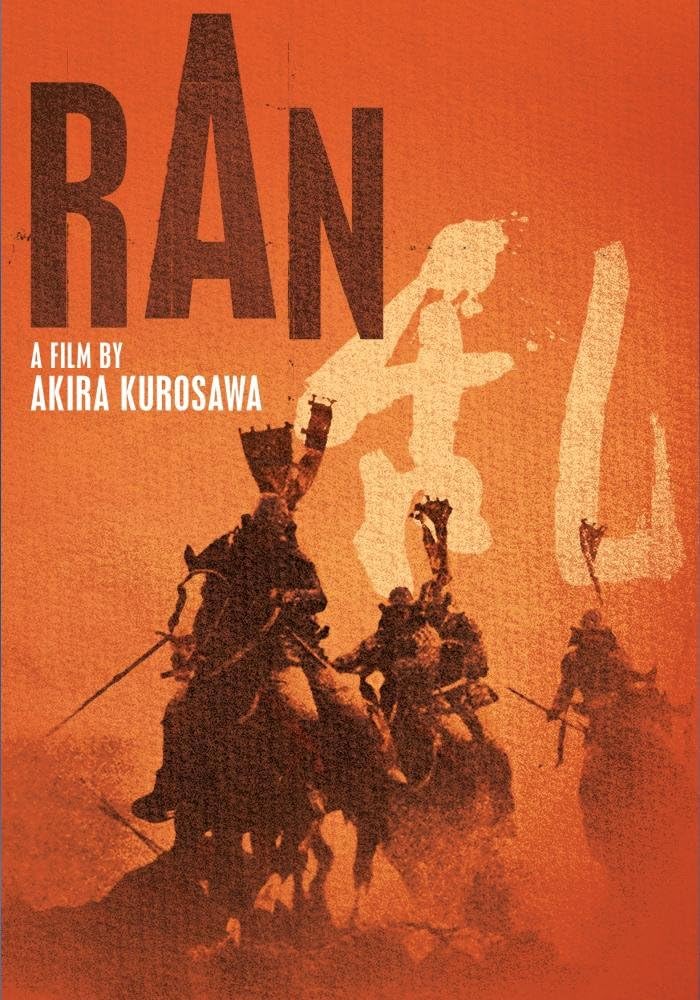
Ran
Product ID: 14880869
Details
- FormatNTSC
- GenreAction &
- Runtime2 hours and 42
- StudioLionsgate
Desertcart purchases this item on your behalf and handles shipping, customs, and support to Mongolia.
Akira Kurosawa's brilliantly conceived retelling of Shakespeare's KING LEAR magically mixes Japanese history, Shakespeare's plot and Kurosawa's own feelings about loyalty in the epic masterpiece, RAN. Set in 16th century Japan, RAN relates the tale of how an aging ruler, Lord Hidetora (Tatsuya Nakadai), announces his intention to divide his land equally among his three sons. Hidetora's decision to step down unleashes a power struggle among the three heirs when he falls prey to the false flattery bestowed upon him by the two older sons and banishes the youngest for speaking the truth. That ruthless betrayal ultimately drives Hidetora insane, destroying his entire family and kingdom. Deep human emotion and outstanding acting combine to create one of the most acclaimed foreign films of all time. Review: Why I like this film, and think it unparalleled. - Why I love RAN I don't identify with any of the characters in the film, save maybe a bit with Saburo the blue clad brother of the three brother characters in this film. There is aboslutely no one in here who is worth much sympathy. What this film is to me is a kind of anthropological analysis. No matter how far mankind reaches for social perfection to create an order with his fellow simians, no matter how aesthetically pleasing it may appear, no matter how majestic or how much grandeur there is in presentation, mankind must contend with the fact that he is just another species on this planet, and no matter how much cranial energy he puts into his efforts, he still has to fight with himself and his fellow homo-sapien-sapien because of all of his shortcomings. I'm reminded of the gorillas who pound, slap or clap their chests in a display of dominance. Or the rams or other horned beasts that butt heads with one another to compete for the right to mate. It is all about survival. Reptiles have some pretty basic programming; hunt to eat, establish territory, and then take a mate. But they do so without regards to what other reptiles think. Mammals on the other hand, give some consideration to other creatures. Not always, but far more often than reptiles, for reptiles only have basic programming; beat the other guy. Sometimes mammals lack anything more than reptilian thinking, or, worse yet, recognize the way of the reptile, and use it to overcome their fellow mammal. And that's kind of what we have in RAN. And when the main character is shown all that he has done, all the blood he has shed, all the destruction, all or the pain and misery, what does he do? The film's tale is rendered with supreme artistry. A kind of mastery that can only come from the grand-master of film making himself; Akira Kurosawa. Nearly each shot or sequence of shots is a painting. No surprise since Kurosawa trained as a painter in both classic Japanese and European oil disciplines. The lensing, the shot setup (what film historians, isntructors, and snobs call mis-en-scene) or composition, the pacing of the film done in Kurosawa's classic somewhat static style, and the use of color and natural landscape and historical sites, create a visual feast of a movie that, in my personal and not so humble opinion, cannot be paralleled. This is a bleak and dark tale. It is a tragedy. It is, in a very detached and immediate sense, like our own universe. Things in nature, rivers, rocks, sand, wind, the tides, and things beyond our planet, other worlds, other suns, gas and the like, are cold and impersonal. Living creatures struggle to live and thrive in these environments. They prey on other creatures, sometimes their own, and when they get too old or diseased to live, they become prey themselves. RAN has that vibe going for it. We codify it, we try to make sense of it, we create science and art around it, but when it comes right down to it, we sometimes find our fellow man still fraught with faults and shortcomings that bewilder us. For as they strive to out compete the rest of us, and may achieve and amass great wealth and notoriety, they then falter, and in their falling create great social chaos. They create RAN. The jealousies of the guy without a girlfriend who is jealous of the guy with a very attractive girlfriend. Of the poor man jealous of the wealthy man. When such envy goes beyond mere confrontation, and manifests itself in politcal maneuvering and martial efforts by fielding infantry, archers and cavalry, blood is shed. Misery is cast upon all. Violent blood fury passions butcher people and civilization alike. Pain. Constant pain. When jealousies get that old, they become spiteful, and war is waged. But again, on that same level, we can regard it perhaps both as a personal reflection on our fellow man, and instruction to us as a species of the pitfalls of false pride, of celebrating the destruction of one's fellow man, and such revelry and expectancy of reverence can lead to revenge from the most innocuous of sources, with the power to destroy empires. How can we celebrate the destroyer of men who expects love? Or should we have pity on him and understand that he is a reflection of our more base nature? In essence, we are "the gods" looking in on this Greek tragedy. We are reminded that even though we can achieve great things relative to ourselves and those of our fellow species who also reside on this planet, that still have faults. And perhaps more complex faults by our very abilities, than say those of any creature living in the woods, the sea, deserts or forests of this world. In this way it is a kind of reminder of what it means to be a Stewart of ourselves, and guardian of our fellow human, lest RAN be visited upon us. Or, in Kurosawa's own words, why can't people be happy? Or to paraphrase Toshiro Mifune's character from Yojimbo, a long boring life with porridge is best. And that is why I like RAN. That is why this is a masterpiece of cinema. This is why Kurosawa will always be the grand-master of cinematic arts and sciences. 4K UHD review update; So, there's more detail in the 4k release. The image doesn't bounce around from side to side as per previous video releases. The translation is more in sync with the original translation that came with the initial VHS home video release. But, in the end what we're looking at is a criminal scenario, or a worse case scenario. The original Shakespeare play had Lear's daughters coaxing and cajoling men into military adventurism, whereas Kurosawa merely removes the middle "man" (women) and lets the man have at it. This film is aimed at the well to do and educated might-be criminal who is weighing in their minds if they could "get away with murder" for monetary gain. Hence a lot of money dumped into sets, props and so forth. "Why can't people be happy?" says Kurosawa. This film doesn't answer that, but gives a stern warning that money can't buy you happiness. Nor can killing your family and taking what they have. Review: "Man is born crying. When he has cried enough, he dies." - (some mild spoilers follow) From the quiet, pastoral images of soldiers on horseback standing guard on grass covered rolling hills in the opening shots to the achingly sad image of the blind Tsurumaru silhouetted against the sky at the close this is one of the great epics ever placed on film. Ran remains one of Kurosawa's later in life masterpieces. We'll probably not see the likes of him ever again. He is basically to film what Shakespeare is to the play, Beethoven is to music and Tolstoy or Dickens is to the novel. Eternal human themes of life and death are explored (Kurosawa borrows themes from King Lear here and makes it uniquely Japanese) with such visual beauty and impact, you are transported. Certainly, Ran can be placed in the top 5 or so of Kurosawa's filmography right along with the likes of Seven Samurai, Rashomon and Ikiru. There are so many great characters in this film. So much visual beauty. So much blood! The iconic image of Lord Hidetora staggering down the steps of the castle keep that's fully engulfed in flame with the 2 brothers' yellow and red armies on each side of him is seared into the memory. Luckily, the agonizing, step by step 2016 restoration done by the French team at Studio Canal is really amazing. This is certainly the best this film will ever look other than the original theatre release. Fine film grain is present and many medium and close shots are highly detailed. Colors are rich. There is no more jitter to the film image. It is stable as a rock. The 5.1 DTS HD MA sound is clear as a bell with good placement up front. There's no distortion. The Japanese dialog's inflections are heard very well throughout. Be aware that this release is the original European 4k release with a region free 4k main feature film only and region B Blu-ray and bonus disc not playable on US region A players. You'll need to use a region free player or spend a very large sum on the original US release Steel book release to get all 3 region A discs. Good luck on the search as this great masterpiece is worth the time and money to be included in any serious film collection!
| ASIN | B00K5EJHGO |
| Actors | Akira Terao, Daisuke Ryu, Jinpachi Nezu, Mieko Harada, Tatsuya Nakadai |
| Aspect Ratio | 1.78:1 |
| Best Sellers Rank | #39,912 in Movies & TV ( See Top 100 in Movies & TV ) #527 in Military & War (Movies & TV) #4,080 in Action & Adventure DVDs #6,212 in Drama DVDs |
| Customer Reviews | 4.6 4.6 out of 5 stars (1,842) |
| Director | Akira Kurosawa |
| Item model number | B00K5EJHGO |
| MPAA rating | NR (Not Rated) |
| Media Format | NTSC |
| Number of discs | 1 |
| Producers | Masato Hara, Serge Silberman |
| Product Dimensions | 7.5 x 5.5 x 0.5 inches; 3.5 ounces |
| Release date | May 6, 2014 |
| Run time | 2 hours and 42 minutes |
| Studio | Lionsgate |
| Writers | Akira Kurosawa, Hideo Oguni, Masato Ide |
R**T
Why I like this film, and think it unparalleled.
Why I love RAN I don't identify with any of the characters in the film, save maybe a bit with Saburo the blue clad brother of the three brother characters in this film. There is aboslutely no one in here who is worth much sympathy. What this film is to me is a kind of anthropological analysis. No matter how far mankind reaches for social perfection to create an order with his fellow simians, no matter how aesthetically pleasing it may appear, no matter how majestic or how much grandeur there is in presentation, mankind must contend with the fact that he is just another species on this planet, and no matter how much cranial energy he puts into his efforts, he still has to fight with himself and his fellow homo-sapien-sapien because of all of his shortcomings. I'm reminded of the gorillas who pound, slap or clap their chests in a display of dominance. Or the rams or other horned beasts that butt heads with one another to compete for the right to mate. It is all about survival. Reptiles have some pretty basic programming; hunt to eat, establish territory, and then take a mate. But they do so without regards to what other reptiles think. Mammals on the other hand, give some consideration to other creatures. Not always, but far more often than reptiles, for reptiles only have basic programming; beat the other guy. Sometimes mammals lack anything more than reptilian thinking, or, worse yet, recognize the way of the reptile, and use it to overcome their fellow mammal. And that's kind of what we have in RAN. And when the main character is shown all that he has done, all the blood he has shed, all the destruction, all or the pain and misery, what does he do? The film's tale is rendered with supreme artistry. A kind of mastery that can only come from the grand-master of film making himself; Akira Kurosawa. Nearly each shot or sequence of shots is a painting. No surprise since Kurosawa trained as a painter in both classic Japanese and European oil disciplines. The lensing, the shot setup (what film historians, isntructors, and snobs call mis-en-scene) or composition, the pacing of the film done in Kurosawa's classic somewhat static style, and the use of color and natural landscape and historical sites, create a visual feast of a movie that, in my personal and not so humble opinion, cannot be paralleled. This is a bleak and dark tale. It is a tragedy. It is, in a very detached and immediate sense, like our own universe. Things in nature, rivers, rocks, sand, wind, the tides, and things beyond our planet, other worlds, other suns, gas and the like, are cold and impersonal. Living creatures struggle to live and thrive in these environments. They prey on other creatures, sometimes their own, and when they get too old or diseased to live, they become prey themselves. RAN has that vibe going for it. We codify it, we try to make sense of it, we create science and art around it, but when it comes right down to it, we sometimes find our fellow man still fraught with faults and shortcomings that bewilder us. For as they strive to out compete the rest of us, and may achieve and amass great wealth and notoriety, they then falter, and in their falling create great social chaos. They create RAN. The jealousies of the guy without a girlfriend who is jealous of the guy with a very attractive girlfriend. Of the poor man jealous of the wealthy man. When such envy goes beyond mere confrontation, and manifests itself in politcal maneuvering and martial efforts by fielding infantry, archers and cavalry, blood is shed. Misery is cast upon all. Violent blood fury passions butcher people and civilization alike. Pain. Constant pain. When jealousies get that old, they become spiteful, and war is waged. But again, on that same level, we can regard it perhaps both as a personal reflection on our fellow man, and instruction to us as a species of the pitfalls of false pride, of celebrating the destruction of one's fellow man, and such revelry and expectancy of reverence can lead to revenge from the most innocuous of sources, with the power to destroy empires. How can we celebrate the destroyer of men who expects love? Or should we have pity on him and understand that he is a reflection of our more base nature? In essence, we are "the gods" looking in on this Greek tragedy. We are reminded that even though we can achieve great things relative to ourselves and those of our fellow species who also reside on this planet, that still have faults. And perhaps more complex faults by our very abilities, than say those of any creature living in the woods, the sea, deserts or forests of this world. In this way it is a kind of reminder of what it means to be a Stewart of ourselves, and guardian of our fellow human, lest RAN be visited upon us. Or, in Kurosawa's own words, why can't people be happy? Or to paraphrase Toshiro Mifune's character from Yojimbo, a long boring life with porridge is best. And that is why I like RAN. That is why this is a masterpiece of cinema. This is why Kurosawa will always be the grand-master of cinematic arts and sciences. 4K UHD review update; So, there's more detail in the 4k release. The image doesn't bounce around from side to side as per previous video releases. The translation is more in sync with the original translation that came with the initial VHS home video release. But, in the end what we're looking at is a criminal scenario, or a worse case scenario. The original Shakespeare play had Lear's daughters coaxing and cajoling men into military adventurism, whereas Kurosawa merely removes the middle "man" (women) and lets the man have at it. This film is aimed at the well to do and educated might-be criminal who is weighing in their minds if they could "get away with murder" for monetary gain. Hence a lot of money dumped into sets, props and so forth. "Why can't people be happy?" says Kurosawa. This film doesn't answer that, but gives a stern warning that money can't buy you happiness. Nor can killing your family and taking what they have.
O**E
"Man is born crying. When he has cried enough, he dies."
(some mild spoilers follow) From the quiet, pastoral images of soldiers on horseback standing guard on grass covered rolling hills in the opening shots to the achingly sad image of the blind Tsurumaru silhouetted against the sky at the close this is one of the great epics ever placed on film. Ran remains one of Kurosawa's later in life masterpieces. We'll probably not see the likes of him ever again. He is basically to film what Shakespeare is to the play, Beethoven is to music and Tolstoy or Dickens is to the novel. Eternal human themes of life and death are explored (Kurosawa borrows themes from King Lear here and makes it uniquely Japanese) with such visual beauty and impact, you are transported. Certainly, Ran can be placed in the top 5 or so of Kurosawa's filmography right along with the likes of Seven Samurai, Rashomon and Ikiru. There are so many great characters in this film. So much visual beauty. So much blood! The iconic image of Lord Hidetora staggering down the steps of the castle keep that's fully engulfed in flame with the 2 brothers' yellow and red armies on each side of him is seared into the memory. Luckily, the agonizing, step by step 2016 restoration done by the French team at Studio Canal is really amazing. This is certainly the best this film will ever look other than the original theatre release. Fine film grain is present and many medium and close shots are highly detailed. Colors are rich. There is no more jitter to the film image. It is stable as a rock. The 5.1 DTS HD MA sound is clear as a bell with good placement up front. There's no distortion. The Japanese dialog's inflections are heard very well throughout. Be aware that this release is the original European 4k release with a region free 4k main feature film only and region B Blu-ray and bonus disc not playable on US region A players. You'll need to use a region free player or spend a very large sum on the original US release Steel book release to get all 3 region A discs. Good luck on the search as this great masterpiece is worth the time and money to be included in any serious film collection!
映**)
本ソフトは海外でも賛否があるようだ。 しかし、作品が好きなので購入してみた。 が賛より否の方が正しいと実感した。 もちろん、本ソフトが海外公開版であることに不満はない。 肝心なのはソフトの出来。 まるでKADAKAWAの4K修復版BDを、そのままUHDにしたようだ。 4Kにしてはシャープさに欠ける点・何より全体に青みががった画質。 これが全く改善されていない。 僕としては、KADOKAWAが、35mmフィルムから再度修復をしてマスターを制作して決定版のUHDBDを出して欲しいと思う。 このままでは亡き黒澤明監督も浮かばれない。
B**L
Kurosawa es el maestro del dramatismo a través del movimiento.
J**N
This is not really a review, more of a heads up. The description is not 100% correct in that the bluray disc(s) are not region free, they are region B. The 4K is ABC, which is why I ordered it, as I already own an older copy in bluray format, I was simply upgrading. I only wrote this as I have been stung a few times in the last few years with poor descriptions. The movie is great, classic, classic samurai film.
R**D
I saw this when it was released and have wanted to own it ever since. This is Kurosawa's great late masterpiece, a summing up of the themes in his entire oeuvre - war, power, self destruction, history - in an unforgettable retelling of Lear, but with deep references to Japanese culture. I watched this with my son (12), both in a state of utter fascination at the panorama of life and death in this long film. (He was full of questions!) It was an utter delight. ***spoiler alert*** I assume the reader knows the story already. The story takes place in the 16C or so, a time of upheaval and disorder worldwide. An old war lord has spent his life ruthlessly crushing enemies nearby, stopping at nothing in his striving to dominate. Perhaps as a result of his deteriorating mind, perhaps out of guilt at the terrible things he has done, he makes a catastrophically stupid decision - to divide the power of his armies between his sons in order to retire. Only one son opposes this course of action, which his father finds violently offensive. The son is banished, along with a faithful aide. Almost immediately, the two remaining sons begin to flex their muscles, first by humiliating their father - denying him access to their castles with his reduced entourage - and then by besieging him. This is one of the most horribly graphic war scenes I have ever seen, hiding nothing of the blood and meaningless deaths. The father begins to lose his mind, paralyzed in despair and appearing like a popular demon with his ashen face. Once his forces are annihilated and his concubines have committed suicide, he stumbles out of the burning palace. Having been rejoined by the faithful servant and the eunuch court jester, the only refuge he finds is in a filthy shack that houses a boy he blinded years before. This is just one of the past crimes that revisits the war lord, who sees the irony through his psychotic despair. As soon as the sons are rid of him, they turn on eachother. Here, there is a scheming wife, whose family we learn was murdered by war lord soon after his son married her for the purposes of alliance. She is a Shakespearean character, waiting years for revenge and then executing it at exactly the right time to perfection. She sows destruction on an unimaginable scale. As the war lord his last son, the faithful one, the tragedy is complete. This is one of the best films I have ever seen, by far the most intense war film. Its psychology is also realistic, with the self-destructive decision of a father full of guilt. Recommended with the greatest enthusiasm.
M**Z
Żaden HDR! Filtr szary nałożony na całość. Na pocieszenie: BD wygląda prawie tak samo. Do oglądania w nocy, w ciemnzm pokoju tylko i wyłącznie.
Trustpilot
3 days ago
2 weeks ago