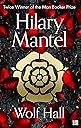
Wolf Hall
Product ID: 254662901
🏆Man Booker Prize Winner
📚500+ pages of immersive Tudor history
⚔️Intricate political intrigue & power plays
Desertcart purchases this item on your behalf and handles shipping, customs, and support to Mongolia.
📖 Unlock the Tudor court’s secrets — don’t miss the novel everyone’s talking about!
Wolf Hall by Hilary Mantel is a Man Booker Prize-winning historical novel that chronicles the rise of Thomas Cromwell in the Tudor court of Henry VIII. With over 500 pages of rich, meticulously researched narrative, it blends political intrigue, complex characters, and vivid historical detail. Celebrated by critics and readers alike, this novel is a definitive must-read for fans of literary fiction and history.


| Best Sellers Rank | #29,506 in Books ( See Top 100 in Books ) #20 in Immigration Fiction #33 in Alternate History Science Fiction #46 in Biographical & Autofiction |
| Customer Reviews | 4.3 out of 5 stars 4,778 Reviews |
N**S
An astounding piece of historical fiction.
𝘞𝘰𝘭𝘧 𝘏𝘢𝘭𝘭 by Hilary Mantel is a historical novel with immense political intrigue and an extraordinary case of rags to riches. A man with an abusive father and a difficult childhood, Thomas Cromwell strives to become the best version of himself that he could. Often mocked for his profession as a lawyer and the right hand man of Thomas Wolsey, the Lord High Chancellor in the court of Henry VIII of England; he finds himself in situations that enabled him to use his persuasive skills and conversing prowess that stimulated his sky high ambitions. King Henry VIII was unhappy. As a King who was driven by his own whims tremendously, he favoured those who aided his wishes and did not dawdle in the elimination of those who didn’t. He was a King who wanted everyone around him to dedicate their lives for his pleasure. Incredibly complacent and lover of all things of beauty and grace, Henry was a King who could be won over by flattery. Cromwell is a jack of all trades and 𝘞𝘰𝘭𝘧 𝘏𝘢𝘭𝘭 is him proving to Henry that he is truly the most able man to be by his side. With Anne Boleyn as his partner in crime, Cromwell sets on a dangerous journey to acquire power second to the King of England. A masterful portrayal of the More- Cromwell conflict, the lively presence of historical characters like Catherine of Aragon, Mary Boleyn and the scandalous setting of the Seymour family home Wolf Hall were all achieved by Mantel’s brilliance. Moreover, Anne Boleyn’s exigent presence in the Tudor court and Cromwell’s muted sense of humour made the novel seemingly elegant in its delivery despite the uncustomary actions of its characters. Mantel’s prose and impeccable research is addictive. To read a novel over 500 pages from the perspective of an unpopular historical figure from one of the most tempestuous periods of English history will seem daunting in the initial pages, but gradually it grows on the reader just like its titular character’s status.
C**N
A must read.
An absolutely unmissable read. History wonderfully retold and perfectly researched. Totally recommend it.
W**R
Excellent, First-Rate Historical Fiction
"Wolf Hall" reduces the sprawling soap opera of Henry VIII's "Great Matter" and his subsequent marriage to Anne Boleyn to a world in small, populated by men of degrees of power who are caught up in this political nightmare whether they wish to be or not. The narrative centers around the still-controversial figure of Henry's favorite "hatchet man," Thomas Cromwell, and spins out as told through his increasingly cold and ambitious eyes. Henry and the "great personages" of the court make relatively few appearances until the second half of the book, instead serving as the larger, often unseen canvas for this tale of grief, sorrow, intrigue, and the dehumanizing force all too often inherit in the exercise of temporal and ecclesiastical power. They are the backdrop against which the lesser - but in many ways no less important - lights spin their plots and grapple with the morality and consequences of their fateful political decisions. Cromwell, in this story, becomes "all too human," not a villian any more than the chill and fanatic St Thomas More or the pleasantly hale, sometime kind, and yet flawed Cardinal Wolsey. By providing Cromwell his often neglected back-story, Mantel allows the reader to understand not only him but also the evolution of his own political and religious attitudes in the high-stakes "sand-castle at high tide" shifting world of Tudor power politics, all overlaid by the increasing sense of dread caused by Henry VIII's expanding obssessions and beginning slide into cruel tyranny with the opening of the drama that will lead to the contrived death of Anne Boleyn. Cromwell the man is a brilliant and astute observer, lawyerly and detached while suffering increasing pangs of conscience as his familial misfortunes grow in stark contrast to his expanding political power. Mantel paints a mechanical mind always working, always working, cognizant of the tightropes of class, wit, business, money, war, marriage, and religion up until he truly becomes the "King's Man" as he rides off to arrange the third marriage to the milky Jane Seymour. But this Cromwell is also cognizant of the things like family and loss as having the deeper meanings, even if he lacks the vocabulary to articulate them as he feels he ought and in light of his achingly slow and fumbling religious awakening, which comes at it does in perfectly believeable fits and starts. Mantel's Cromwell is a man of astute observation and deep intuition, a man of passion he rarely lets show lest one dance step too far carry him off to destruction. For those who have come to expect Cromwell as a new "Iago," this book will savagely disappoint. And this, I think, is a far more credible Cromwell than the cartoonish villain of Bolt's "A Man for All Seasons," full-fleshed and whole blooded, not the slithery, hand-rubbing opportunistic sadist or implied sociopath of far too many other - and lesser - treatments. I have also reviwed the negative comments in this thread, and I have two comments of my own. It is true that Mantel uses a "flashback" style of narrative with sometime bits of "stream of consciousness." "Wolf Hall" can therefore be a difficult read at points, and does command the reader's full attention. But, I have to take grave exception to those who were obviously looking for the more soap-operatic or overtly "serpentine" court-gossipy novel. This is a work of great subtlety, and finely appreciates how the affairs of people of power are actually managed and executed by others in their service, often without their actual knowledge and often at unappreciated great risk. Further, Mantel's writing provides the reflective atmosphere that perfectly patterns the evolution of Cromwell's own entangled personal/political mind. She manages her extended metaphors and historical-literary allusions, not to mention superior command of historical detail, with nothing less than a deft and practiced hand. It was a pleasure to read such thoughtful, elegant, and - at points - even inspired prose. I recommend "Wolf Hall" without reservation. True, it can be a hard read. It is not a Tudor soap opera with the usual cast of heroes and grotesques, but rather profoundly three-dimensional characters. But it is one of the best works of historical fiction about the Tudor epoch I have enjoyed in a long, long while.
S**T
Magnum Opus
This book is difficult to describe. It captures in its lucid style the ephemeral associations of thought every moment produces, and yet because it follows intelligent people with lots of experience, those associations much more are and sometimes develop marvelous new aspects and threads of thought and action. It is therefore certainly a text, that can be reread several times for proper appreciation. Also, this book is a grand example of description, how thought and perspective influence attitude in different characters with different goals, different histories and different levels of power, both mentally and outwardly. These givens of a person's outset, how they influence decisions and how again the decisions influence the person are ably related. I suspect it to be the case, that the author gave several characters quite a tendency of her own, as history does not generally relate stories in the detail presented in this book, and not as thoroughly. Yet, when the filling in of details is so realistically done, with a touch of brilliant finesse, that can hardly be a negative comment. So one turns to the history books and biographies for what is truely known, as the author must have done, and to this book for some entertainment, enlightenment and education of the mind. If you are a thinker, you may find this book to fit in nicely and to give you a few valuable inputs. The fact then, that it is partly imagined and not strict law of existence, but one possibility of many, makes it lighter to digest. Its a book of such beauty, that one would seem to want to keep it to oneself. But then that would be unfair. I will admit, that the behaviour in this book is not only nice and level, that it is not a light read. But it thus better mimics the real world, and while not omitting ideas of friendship and trust, it avoids being a farce of empty positivity.
A**R
Love this book!
Bought one for my friend because I really enjoyed it and she loved historical fiction. (Good enough to buy the other two in the series)
Trustpilot
2 weeks ago
2 days ago