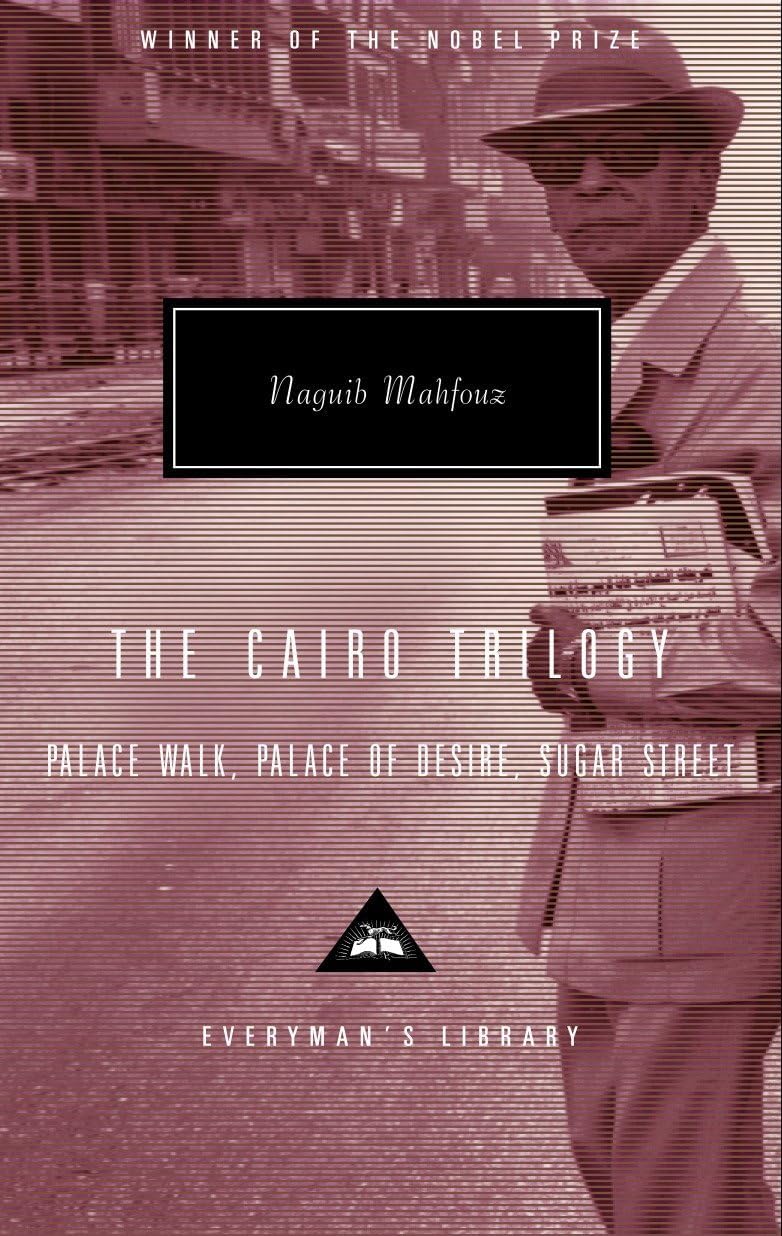
The Cairo Trilogy: Palace Walk, Palace of Desire, Sugar Street (Everyman's Library)
Product ID: 3778114
Buy anything from 5,000+ international stores. One checkout price. No surprise fees. Join 2M+ shoppers on Desertcart.
Desertcart purchases this item on your behalf and handles shipping, customs, and support to Mongolia.
Nobel Prize–winner Naguib Mahfouz’s magnificent epic trilogy of colonial Egypt— Palace Walk , Palace of Desire , and Sugar Street —together for the first time in one beautiful hardcover volume. The masterwork of the Nobel Prize-winning author, the three novels of The Cairo Trilogy trace three generations of the family of tyrannical patriarch Al-Sayyid Ahmad Abd al-Jawad, who rules his household with a strict hand while living a secret life of self-indulgence. Palace Walk introduces us to his gentle, oppressed wife, Amina, his cloistered daughters, Aisha and Khadija, and his three sons–the tragic and idealistic Fahmy, the dissolute hedonist Yasin, and the soul-searching intellectual Kamal. Al-Sayyid Ahmad’s rebellious children struggle to move beyond his domination in Palace of Desire , as the world around them opens to the currents of modernity and political and domestic turmoil brought by the 1920s. Sugar Street brings Mahfouz’s vivid tapestry of an evolving Egypt to a dramatic climax as the aging patriarch sees one grandson become a communist, one a Muslim fundamentalist, and one the lover of a powerful politician. Throughout the trilogy, the family’s trials mirror those of their turbulent country during the years spanning the two World Wars, as change comes to a society that has resisted it for centuries. Filled with compelling drama, earthy humor, and remarkable insight, “ The Cairo Trilogy extends our knowledge of life; it also confirms it” ( The Boston Globe ). Everyman's Library pursues the highest production standards, printing on acid-free cream-colored paper, with full-cloth cases with two-color foil stamping, decorative endpapers, silk ribbon markers, European-style half-round spines, and a full-color illustrated jacket. Contemporary Classics include an introduction, a select bibliography, and a chronology of the author's life and times. Review: Egyptian Culture, Human Nature, Comedy & Tragedy, Politics & Art, Great Characters & Great Writing - My husband took A second wife When wedding henna still Was fresh Upon my hands. The day he brought Her home, her Presence Seared my Flesh. Characters in Naguib Mahfouz’s The Cairo Trilogy (1956-58) sometimes sing popular songs like that. The Egyptian Nobel Prize winning author’s work is a semi-autobiographical look at vivid and intense moments in the lives of the members of a Cairene family living in the old part of the city in the first half of the 20th century, when Egypt was struggling for independence from England. The middle-aged patriarch Al-Sayyid Ahmad 'Abd al-Jawad is a terrifying tyrant at home. He makes his sons wait to eat till he leaves the table, refuses to let his wife Amina leave the house, and decides who his children marry: “I’m a man. I’m the one who commands and forbids. I will not accept any criticism of my behavior. All I ask of you is to obey me. Don’t force me to discipline you.” Although Al-Sayyid is a humorless, pious Muslim man at home, when out partying with his cronies he is a pleasure seeking, joke telling, tambourine playing, song singing, alcohol abusing, womanizing playboy. Amina, who when not cooking and cleaning and supporting her children stands in her rooftop garden gazing longingly at the minarets of the mosques she can never visit, is the heart of the family. Eldest son Yasin has inherited his father’s sensual appetites without any of his self-control; middle son Fahmy is a naive law student devoted to Egyptian nationalist-independence; youngest son Kamal (based partly on Mahfouz) is a lively, loving, imaginative boy. Eldest daughter Khadija has an acerbic tongue that often makes fun of people. Youngest daughter Aisha is fair, beautiful, and unworldly. The trilogy depicts the family aging as their country changes. In the first book, Palace Walk (1956), which covers the years 1917-19, Al-Sayyid rules at home and plays outside, Amina takes care of her family while trying to visit the mosque of Al-Husayn, Yasin fails to control his lusts and discovers his father’s dual nature, Aisha and Khadija get involved in matrimony, Fahmy gets involved in revolution, and Kamal tries to understand his changing family. The second book, Palace of Desire (1957), taking place from 1924 to 1927, focuses on the now teenaged Kamal, particularly on his quest to find truth, goodness, and beauty by studying world philosophy while doubting everything in life and on his one-sided idealized love for Aida, an older girl from a wealthy family. “It seemed he had fallen in love in order to master the dictionary of pain.” Acting as a foil to Kamal’s love are the comical sexual misadventures of Yasin, who marries the wrong women for the wrong reasons, and of Al-Sayyid, who gets back in the adultery game after a five-year hiatus. Though just as funny as the first two, the third novel, Sugar Street (1958), covering 1935-44, is sadder than the first two. Here the family is really aging, especially the once vigorous patriarch and his long-suffering wife, and there is much death. “It was sad to watch a family age.” The story centers on Kamal’s “infernal vacillation” as to whether or not to marry, on his new friendship with a kindred-spirit writer, and on his his nephews, Abd, who joins the new Muslim Brotherhood, grows a beard, and becomes quite the fundamentalist, and Ahmad, who joins a Marxist magazine and becomes quite the atheist. Throughout the trilogy Mahfouz writes interesting details about Egyptian family life in the big city in the first half of the 20th century, as well as about the education and class systems, wedding, marriage, divorce, death, funeral, and religious customs, café and brothel culture, gender roles, and politics. He relishes the Egyptian tendency to spice up life and defuse stress with irony. “If our houses are destroyed [in an air raid], they’ll have the honor of being demolished by the most advanced inventions of modern science.” And the Egyptian (or Arabic?) tendency whenever too happy or proud or sad etc. to say something like, “There is no god but God, and Muhammad is the Messenger of God.” (The translation of the trilogy is fine, though I sometimes wished the translator would have rendered “God” and “Lord” as Allah.) In addition to particular details of Egyptian culture, Mahfouz writes about universal aspects of human nature, as in the following quotable lines: “Patriotism’s a virtue, if it’s not tainted by xenophobia”; and “People need confidential advice, consolation, joy, guidance, light, and journeys to all regions of the inhabited world and of the soul. That’s what art is.” He leads us into the heads and hearts of his characters, as in the following emotional lines: “In this manner he was afforded an opportunity to feel what a dead man might if still conscious,” “His secret flowed out of him like blood from a wound,” and “Watching her eat pastries was even sweeter than eating them himself.” He also writes wonderful similes with original, surprising, and perfectly apt vehicles, like: “His eyes ran over her body as quickly and greedily as a mouse on a sack of rice looking for a place to get in,” “There were pure white billows resembling pools of light over the Qala’un and Barquq minarets,” and “She was nothing but a symbol, like a deserted ruin that evokes exalted historic memories.” He also writes many humorously cynical lines, like “Ridwan was so proud they were there that his pride almost obscured his grief,” and “But life is full of prostitutes of various types. Some are cabinet ministers and others authors.” The Cairo Trilogy is 1323 pages long. Sometimes my attention waned. But it is full of great scenes, fine writing, authentic people, Cairene culture, human nature, ironic humor, devastating tragedy, and all sorts of interesting ideas about love, families, religion, politics, philosophy, life, and death. Readers fond of classic world literature should like it. **I read the Kindle version and noticed no typos** Review: A Magisterial Work - Whichever way a critic chooses to assess the three books that comprise The Cairo Trilogy (Palace Walk, Palace of Desire, and Sugar Street) one arrives at a similar conclusion: this is a magisterial work. At the level of sheer storytelling, the narrative is amazing in its depth and scope of chronicling various individuals over three generations in the al-Jawad family. For me, the most satisfying aspect of the three books is the cerebral insight in which Mahfouz investigates each major character throughout successive generations. The result is a family saga immensely rich in its range of personalities. Readers feel as though they are experiencing emotions through a kaleidoscope. Mahfouz astonishes with his ability to channel the intimate thoughts of each character in order to unveil their deepest secrets. He probes his characters' minds like a psychiatrist performing clinical evaluations to determine the source of their actions and behavior. Moreover, Mahfouz penetrates the tantalizing matters of the heart. He gives us characters in their most human form: in both their pain and joy, through their hopes and despairs, and during their perils of love and loss. The central figure spanning all three volumes is the imposing patriarch, Ahmad Abd al-Jawad. He dominates over his household with the authority of a tyrannical king. He presents himself as a man living up to the highest standards of religion and morality. By day, among his family he acts like a man of stern principles and devout prayer. Yet his hypocrisy is dually noted early on in the narrative, as he is also a man of uninhibited indulgence. By night, he carouses, drinks, and engages in adultery. He represents Mahfouz's quintessential literary focus on allegory, which is prevalent throughout most of the trilogy. Al-Sayyid Ahmad embodies someone who thinks he is free to do anything he wants without consequence, while at the same time he forbids others from the same behavior. In other words, Ahmad portrays himself as everything he is not, just as the historical backdrop of the trilogy shows how the free reign of British colonialism to do whatever it wants is anything but free of guilt. Palace Walk, volume 1 of the trilogy, shifts gears from a family saga to a historical drama when Mahfouz begins to highlight the forces and events surrounding the Egyptian revolution against the British occupation. With extraordinary realism and visceral affect, he brings to life the sights, sounds, and motives of the populace to confront the injustices of colonialism. He inserts the al-Jawad family in the hub of this maelstrom. Of the five children of al-Sayyid Ahmad, it is the middle son, the idealist and erudite Fahmy, who falls victim to martyrdom, even as his father defies him not to pledge the rebellion of 1919. The oldest son, Yasin, is from Ahmad's first marriage, and he portrays the second generation figure whose misguidance perpetuates the same sins of debauchery as his father. Ahmad's two daughters are diametrical opposites both in appearance and demeanor. The older daughter, Khadjia, has unflattering features, yet she is full of energy and seemingly cursed with a flair for sarcasm and cheekiness. Her younger sister, Aisha, is a radiant blonde with a voice like a songbird, yet she is prone to languishing and reverie. The most compelling child is the youngest, Kamal. Prone to playfulness and lies, he is mischievous with inquiry about the world and fascinated with religious studies. Like all the siblings, Kamal is terrified of his father. Then there is the matriarch, Amina, a paragon of nurturing and caring. She does for her family what any ideal mother would do, and yet she suffers the duality of pretending to turn a blind eye on her husband's transgressions. Palace Walk takes readers through the daily struggles and joys of the family up until the 1919 nationalist revolution in which Fahmy loses his life. In volume 2, Palace of Desire, the saga of the al-Jawad family recommences in 1924 with the British reaching a rapprochement with the widely popular Wafd leader, Sa'dZaghlul. In this second volume, the fate of the next generation plays out. After several affairs and scandals, Yasin attempts to find monogamy with his second wife Zaynab, but again he fails to do so. Although she is the younger sister, Aisha is wed off to Khalil Shawkat, and shortly thereafter her older sister Khadija follows suit by having her marriage arranged to Khalil's much older brother, Ibrahim. The children of both these couples are in their infancy as this novel proceeds, but the most compelling figure in volume 2 is Kamal, the youngest sibling of al-Sayyid Ahmad and Amina. Now seventeen, Kamal has passed his exams to earn his baccalaureate. Against the wishes of his father, he insists on purposing philosophical truths and the search for meaning in an existential world. Kamal's disavowal of religion places him in conflict with his father, who pledges the fundamentalist tenets of Islam. As a free thinker catapulted into the field of modern science's quest for meaning and understanding, Kamal falls victim to despondency after he suffers from the agony of unrequited love. Palace of Desire focuses on Kamal's plight as the central figure of the second generation. His modernist vision of the world, as reliant on science and reason, reflects the Wafd Party's nationalist ideology of governing the nation free from the constraints of Islam as a political system. When the second book ends with the passing of the leader Sa'd, one sees the parallel between the painful end of an era and the pain Kamal feels with his own lofty hopes for love shattering around him. By volume 3, Sugar Street, it is now 1935, and the third generation has become the focal point. This generation is most aptly depicted through the two polarizing figures of Abd al-Muni'm and Ahmad, the two headstrong sons of Khadija and Ibrahim. Abd al Muni'm grafts himself to the fanaticism preached by Shaykh Ali al-Munufi, a religious zealot devoted to the budding philosophy that the Quran's teachings should be implemented as a political system and code, even in the modern world. As leader of the Muslim Brethren, al-Munufi ensnares vulnerable young minds such as Abd al-Muni'm during a time in Egypt's history when the country's political turmoil continues to consume everyday society. On the opposing side of ideologies, Ahmad finds solace in following AdliKarim, the open-minded Editor-in-Chief of The New Man magazine. Karim views the Wafdists as the starting point of Egypt's national movement towards independence and democracy. He, however, believes the nation must go beyond developing social freedom. Ahmad latches onto Karim's ideas and supports the mission of The New Man to confront the fanatics while at the same time promoting scientific mentality. Both brothers heed the patriotic call for revolution and independence, yet both see entirely different ways of achieving liberation from British rule. With a host of other family characters, friends, and acquaintances to supplement this diversion of the brothers' philosophies, Mahfouz ultimately brings this grand trilogy to a summation with the government's mass crackdown on political activists on each side of the divide. The arrests of both Abd al Muni'm and Ahmad bring this monumental work to a close. In its totality, Mahfouz uses the three novels of The Cairo Trilogy to chart Egypt's tumultuous history through the meditations of various family members with distinctively different perceptions on life. He achieves this by also exposing and confronting the ideologies of both repressive colonialism and radical Islam. What he creates in the process is a breathtaking work of vivacity and bustle. The trilogy is allegorical and literal in his depictions of the al-Jawad family as a microcosm for the subsequent historical eras that three generations of the family endure. What stands out to me in everything that Mahfouz accomplishes is that he offers us a vast array of characters that go beyond giving us insight to the emotional chambers of their hearts. He reveals to us the essence of their souls so that we might seek to turn a mirror on ourselves and examine what it is in each of us that yearns for a better understanding of humanity and what it means to be human. Having read the trilogy as a singular work, I believe in order to gain full appreciation of the novels, it is important to read them together as one book. So much transpires and reading the books separately or out of sequence may prevent one from experiencing the significance Mahfouz assigns to certain characters in each generation. For example, the patriarch al-Sayyid Ahmad, is unyielding in his authority over his family from the beginning of volume 1, Palace Walk. However, with his aging and with the influence of modernity on his beliefs, he is shown as capable of changing. What is uniquely notable is that his grandson Ahmad (one of the prominent figures of volume 3, Sugar Street) clearly symbolizes tolerance and open-mindedness. To gain the full effect of this fascinating generational dichotomy requires an understanding of Ahmad the grandfather from Palace Walk. This type of symbolic contrast between characters occurs throughout the three novels, but without knowledge of what certain characters are like early in their lives, the effect of who they are in different volumes is not as impactful.
| Best Sellers Rank | #88,593 in Books ( See Top 100 in Books ) #119 in Multigenerational Fiction (Books) #1,571 in Family Saga Fiction #5,609 in Literary Fiction (Books) |
| Customer Reviews | 4.5 out of 5 stars 594 Reviews |
J**N
Egyptian Culture, Human Nature, Comedy & Tragedy, Politics & Art, Great Characters & Great Writing
My husband took A second wife When wedding henna still Was fresh Upon my hands. The day he brought Her home, her Presence Seared my Flesh. Characters in Naguib Mahfouz’s The Cairo Trilogy (1956-58) sometimes sing popular songs like that. The Egyptian Nobel Prize winning author’s work is a semi-autobiographical look at vivid and intense moments in the lives of the members of a Cairene family living in the old part of the city in the first half of the 20th century, when Egypt was struggling for independence from England. The middle-aged patriarch Al-Sayyid Ahmad 'Abd al-Jawad is a terrifying tyrant at home. He makes his sons wait to eat till he leaves the table, refuses to let his wife Amina leave the house, and decides who his children marry: “I’m a man. I’m the one who commands and forbids. I will not accept any criticism of my behavior. All I ask of you is to obey me. Don’t force me to discipline you.” Although Al-Sayyid is a humorless, pious Muslim man at home, when out partying with his cronies he is a pleasure seeking, joke telling, tambourine playing, song singing, alcohol abusing, womanizing playboy. Amina, who when not cooking and cleaning and supporting her children stands in her rooftop garden gazing longingly at the minarets of the mosques she can never visit, is the heart of the family. Eldest son Yasin has inherited his father’s sensual appetites without any of his self-control; middle son Fahmy is a naive law student devoted to Egyptian nationalist-independence; youngest son Kamal (based partly on Mahfouz) is a lively, loving, imaginative boy. Eldest daughter Khadija has an acerbic tongue that often makes fun of people. Youngest daughter Aisha is fair, beautiful, and unworldly. The trilogy depicts the family aging as their country changes. In the first book, Palace Walk (1956), which covers the years 1917-19, Al-Sayyid rules at home and plays outside, Amina takes care of her family while trying to visit the mosque of Al-Husayn, Yasin fails to control his lusts and discovers his father’s dual nature, Aisha and Khadija get involved in matrimony, Fahmy gets involved in revolution, and Kamal tries to understand his changing family. The second book, Palace of Desire (1957), taking place from 1924 to 1927, focuses on the now teenaged Kamal, particularly on his quest to find truth, goodness, and beauty by studying world philosophy while doubting everything in life and on his one-sided idealized love for Aida, an older girl from a wealthy family. “It seemed he had fallen in love in order to master the dictionary of pain.” Acting as a foil to Kamal’s love are the comical sexual misadventures of Yasin, who marries the wrong women for the wrong reasons, and of Al-Sayyid, who gets back in the adultery game after a five-year hiatus. Though just as funny as the first two, the third novel, Sugar Street (1958), covering 1935-44, is sadder than the first two. Here the family is really aging, especially the once vigorous patriarch and his long-suffering wife, and there is much death. “It was sad to watch a family age.” The story centers on Kamal’s “infernal vacillation” as to whether or not to marry, on his new friendship with a kindred-spirit writer, and on his his nephews, Abd, who joins the new Muslim Brotherhood, grows a beard, and becomes quite the fundamentalist, and Ahmad, who joins a Marxist magazine and becomes quite the atheist. Throughout the trilogy Mahfouz writes interesting details about Egyptian family life in the big city in the first half of the 20th century, as well as about the education and class systems, wedding, marriage, divorce, death, funeral, and religious customs, café and brothel culture, gender roles, and politics. He relishes the Egyptian tendency to spice up life and defuse stress with irony. “If our houses are destroyed [in an air raid], they’ll have the honor of being demolished by the most advanced inventions of modern science.” And the Egyptian (or Arabic?) tendency whenever too happy or proud or sad etc. to say something like, “There is no god but God, and Muhammad is the Messenger of God.” (The translation of the trilogy is fine, though I sometimes wished the translator would have rendered “God” and “Lord” as Allah.) In addition to particular details of Egyptian culture, Mahfouz writes about universal aspects of human nature, as in the following quotable lines: “Patriotism’s a virtue, if it’s not tainted by xenophobia”; and “People need confidential advice, consolation, joy, guidance, light, and journeys to all regions of the inhabited world and of the soul. That’s what art is.” He leads us into the heads and hearts of his characters, as in the following emotional lines: “In this manner he was afforded an opportunity to feel what a dead man might if still conscious,” “His secret flowed out of him like blood from a wound,” and “Watching her eat pastries was even sweeter than eating them himself.” He also writes wonderful similes with original, surprising, and perfectly apt vehicles, like: “His eyes ran over her body as quickly and greedily as a mouse on a sack of rice looking for a place to get in,” “There were pure white billows resembling pools of light over the Qala’un and Barquq minarets,” and “She was nothing but a symbol, like a deserted ruin that evokes exalted historic memories.” He also writes many humorously cynical lines, like “Ridwan was so proud they were there that his pride almost obscured his grief,” and “But life is full of prostitutes of various types. Some are cabinet ministers and others authors.” The Cairo Trilogy is 1323 pages long. Sometimes my attention waned. But it is full of great scenes, fine writing, authentic people, Cairene culture, human nature, ironic humor, devastating tragedy, and all sorts of interesting ideas about love, families, religion, politics, philosophy, life, and death. Readers fond of classic world literature should like it. **I read the Kindle version and noticed no typos**
R**K
A Magisterial Work
Whichever way a critic chooses to assess the three books that comprise The Cairo Trilogy (Palace Walk, Palace of Desire, and Sugar Street) one arrives at a similar conclusion: this is a magisterial work. At the level of sheer storytelling, the narrative is amazing in its depth and scope of chronicling various individuals over three generations in the al-Jawad family. For me, the most satisfying aspect of the three books is the cerebral insight in which Mahfouz investigates each major character throughout successive generations. The result is a family saga immensely rich in its range of personalities. Readers feel as though they are experiencing emotions through a kaleidoscope. Mahfouz astonishes with his ability to channel the intimate thoughts of each character in order to unveil their deepest secrets. He probes his characters' minds like a psychiatrist performing clinical evaluations to determine the source of their actions and behavior. Moreover, Mahfouz penetrates the tantalizing matters of the heart. He gives us characters in their most human form: in both their pain and joy, through their hopes and despairs, and during their perils of love and loss. The central figure spanning all three volumes is the imposing patriarch, Ahmad Abd al-Jawad. He dominates over his household with the authority of a tyrannical king. He presents himself as a man living up to the highest standards of religion and morality. By day, among his family he acts like a man of stern principles and devout prayer. Yet his hypocrisy is dually noted early on in the narrative, as he is also a man of uninhibited indulgence. By night, he carouses, drinks, and engages in adultery. He represents Mahfouz's quintessential literary focus on allegory, which is prevalent throughout most of the trilogy. Al-Sayyid Ahmad embodies someone who thinks he is free to do anything he wants without consequence, while at the same time he forbids others from the same behavior. In other words, Ahmad portrays himself as everything he is not, just as the historical backdrop of the trilogy shows how the free reign of British colonialism to do whatever it wants is anything but free of guilt. Palace Walk, volume 1 of the trilogy, shifts gears from a family saga to a historical drama when Mahfouz begins to highlight the forces and events surrounding the Egyptian revolution against the British occupation. With extraordinary realism and visceral affect, he brings to life the sights, sounds, and motives of the populace to confront the injustices of colonialism. He inserts the al-Jawad family in the hub of this maelstrom. Of the five children of al-Sayyid Ahmad, it is the middle son, the idealist and erudite Fahmy, who falls victim to martyrdom, even as his father defies him not to pledge the rebellion of 1919. The oldest son, Yasin, is from Ahmad's first marriage, and he portrays the second generation figure whose misguidance perpetuates the same sins of debauchery as his father. Ahmad's two daughters are diametrical opposites both in appearance and demeanor. The older daughter, Khadjia, has unflattering features, yet she is full of energy and seemingly cursed with a flair for sarcasm and cheekiness. Her younger sister, Aisha, is a radiant blonde with a voice like a songbird, yet she is prone to languishing and reverie. The most compelling child is the youngest, Kamal. Prone to playfulness and lies, he is mischievous with inquiry about the world and fascinated with religious studies. Like all the siblings, Kamal is terrified of his father. Then there is the matriarch, Amina, a paragon of nurturing and caring. She does for her family what any ideal mother would do, and yet she suffers the duality of pretending to turn a blind eye on her husband's transgressions. Palace Walk takes readers through the daily struggles and joys of the family up until the 1919 nationalist revolution in which Fahmy loses his life. In volume 2, Palace of Desire, the saga of the al-Jawad family recommences in 1924 with the British reaching a rapprochement with the widely popular Wafd leader, Sa'dZaghlul. In this second volume, the fate of the next generation plays out. After several affairs and scandals, Yasin attempts to find monogamy with his second wife Zaynab, but again he fails to do so. Although she is the younger sister, Aisha is wed off to Khalil Shawkat, and shortly thereafter her older sister Khadija follows suit by having her marriage arranged to Khalil's much older brother, Ibrahim. The children of both these couples are in their infancy as this novel proceeds, but the most compelling figure in volume 2 is Kamal, the youngest sibling of al-Sayyid Ahmad and Amina. Now seventeen, Kamal has passed his exams to earn his baccalaureate. Against the wishes of his father, he insists on purposing philosophical truths and the search for meaning in an existential world. Kamal's disavowal of religion places him in conflict with his father, who pledges the fundamentalist tenets of Islam. As a free thinker catapulted into the field of modern science's quest for meaning and understanding, Kamal falls victim to despondency after he suffers from the agony of unrequited love. Palace of Desire focuses on Kamal's plight as the central figure of the second generation. His modernist vision of the world, as reliant on science and reason, reflects the Wafd Party's nationalist ideology of governing the nation free from the constraints of Islam as a political system. When the second book ends with the passing of the leader Sa'd, one sees the parallel between the painful end of an era and the pain Kamal feels with his own lofty hopes for love shattering around him. By volume 3, Sugar Street, it is now 1935, and the third generation has become the focal point. This generation is most aptly depicted through the two polarizing figures of Abd al-Muni'm and Ahmad, the two headstrong sons of Khadija and Ibrahim. Abd al Muni'm grafts himself to the fanaticism preached by Shaykh Ali al-Munufi, a religious zealot devoted to the budding philosophy that the Quran's teachings should be implemented as a political system and code, even in the modern world. As leader of the Muslim Brethren, al-Munufi ensnares vulnerable young minds such as Abd al-Muni'm during a time in Egypt's history when the country's political turmoil continues to consume everyday society. On the opposing side of ideologies, Ahmad finds solace in following AdliKarim, the open-minded Editor-in-Chief of The New Man magazine. Karim views the Wafdists as the starting point of Egypt's national movement towards independence and democracy. He, however, believes the nation must go beyond developing social freedom. Ahmad latches onto Karim's ideas and supports the mission of The New Man to confront the fanatics while at the same time promoting scientific mentality. Both brothers heed the patriotic call for revolution and independence, yet both see entirely different ways of achieving liberation from British rule. With a host of other family characters, friends, and acquaintances to supplement this diversion of the brothers' philosophies, Mahfouz ultimately brings this grand trilogy to a summation with the government's mass crackdown on political activists on each side of the divide. The arrests of both Abd al Muni'm and Ahmad bring this monumental work to a close. In its totality, Mahfouz uses the three novels of The Cairo Trilogy to chart Egypt's tumultuous history through the meditations of various family members with distinctively different perceptions on life. He achieves this by also exposing and confronting the ideologies of both repressive colonialism and radical Islam. What he creates in the process is a breathtaking work of vivacity and bustle. The trilogy is allegorical and literal in his depictions of the al-Jawad family as a microcosm for the subsequent historical eras that three generations of the family endure. What stands out to me in everything that Mahfouz accomplishes is that he offers us a vast array of characters that go beyond giving us insight to the emotional chambers of their hearts. He reveals to us the essence of their souls so that we might seek to turn a mirror on ourselves and examine what it is in each of us that yearns for a better understanding of humanity and what it means to be human. Having read the trilogy as a singular work, I believe in order to gain full appreciation of the novels, it is important to read them together as one book. So much transpires and reading the books separately or out of sequence may prevent one from experiencing the significance Mahfouz assigns to certain characters in each generation. For example, the patriarch al-Sayyid Ahmad, is unyielding in his authority over his family from the beginning of volume 1, Palace Walk. However, with his aging and with the influence of modernity on his beliefs, he is shown as capable of changing. What is uniquely notable is that his grandson Ahmad (one of the prominent figures of volume 3, Sugar Street) clearly symbolizes tolerance and open-mindedness. To gain the full effect of this fascinating generational dichotomy requires an understanding of Ahmad the grandfather from Palace Walk. This type of symbolic contrast between characters occurs throughout the three novels, but without knowledge of what certain characters are like early in their lives, the effect of who they are in different volumes is not as impactful.
C**S
An Interesting Life
Carefully and sweetly relays a tumultuous family history that left me with earnest appreciation of their heritage and its challenges. I was left bonded to the characters. Well done.
D**S
A Classic, stunning and wonderful
This book was, frankly, a revelation to me. Naguib Mahfouz is the only Arab author to ever win a Nobel Prize for literature, and it's easy to see why he won, if you base your judgement on this volume. This book is a compilation of his best-known and best-regarded work, three books which together are referred to as the Cairo Trilogy. Originally, the author had planned the whole work as a single novel, but after he finished it the publisher told him that a 1300 page novel wasn't possible in the 1950's Arab world, so they split it into three separate novels, with the original title of the whole book serving as the title for the first of the three novels: Palace Walk. Palace of Desire follows it, and Sugar Street concludes the trio. Mahfouz is a remarkable writer. The book spans 30 years at the beginning of the 20th Century, in Cairo of course, and follows the lives of an extended family during this time. He spends an enormous amount of time at the beginning of the book establishing character and setting. The opening 100 or so pages follow the various members of the family through a single day in their lives, starting with the mother getting up to start the day, and following in turn her, her husband, and their children as they perform various tasks during the day. The narrative then takes off and follows these individuals through various calamities (one of the sons gets killed in a demonstration, the father is briefly pressed into service to help with fortification construction, and so forth). He reserves judgement as far as the characters are concerned, tells you how they rationalize their actions when they do something less than perfect, and lets the reader see the warts of each of the characters individually. This is a long, involved, carefully written book. Frankly it invites comparison with almost any other epic novel that covers a generation or two like this, and it's actually better than more than a few of them. It also has, as a sidelight, insight into the character of the nation of Egypt, its people, and especially it spends a great deal of time discussing the character of the city, who lives their, and their attitude towards their neighbors. It's intensely interesting, frankly pretty well written (the translation is very easy to read) and I enjoyed it a great deal.
K**R
A Nobel prize winner who should be read!
The Cairo Trilogy was one of the most fascinating books I have read. It is extremely well written (the author won a Nobel Prize). It tells us the story of an Egyptian family since way before Egypt's independence from England up to the end of World War II -- in other words, for most of the 20th century. Through the eyes and lives of its members, we are able to follow the history of Egypt and the changes that the Egyptian society underwent without the cold feeling of reading a history book. Quite the opposite, our journey is full of emotions. The characters in the story are very well described, and we are sharing their lives for many years, so that we feel that we know them well. We become familiar with all of their dimensions, nothing is black and white. Even the character who we love to hate in the first of the books in the trilogy, we learn to love in the third book. They become our friends. I fell in love with Kamal, I suffered with Aisha and Amina, and I was able to understand Al Sayid Ahmad and Yasin to the point of forgiving them for their flaws. I am not the most eloquent of writers (as it is probably obvious), and I never write book reviews, but this book so moved me that I feel compelled to tell others to read it. The author's writing is so vivid, I felt I was living with this family in the most beautiful neighborhoods in Cairo -- which I never visited. I almost feel I can go to Cairo now and walk through these neighborhoods without a guide. You should definitely read it. I dare guess that you, like me, will have a hard time putting the book down.
C**R
Glimpse Into a Time Capsule of Arabic Middle Class Urban Cairo During the First Half of the Twentieth Century
The following are three separate reviews of the trilogy parts: Palace Walk (The Cairo Trilogy #1) by Naguib Mahfouz Originally published in Arabic in 1956, this novel was written by Egyptian writer Naguib Mahfouz, winner of the 1988 Nobel Prize in Literature. It is the first book of the Cairo Trilogy that was translated into English in 1990. The setting of the novel is Cairo during and just after World War I, 1917 to 1919. Most of the story focuses on the life of one family living on a street named "Palace Walk," and toward the end the plot spreads to include demonstrations and protests leading up to the nationalist revolution of 1919. The story provides a thorough description of a time and place as well as providing intimate character development of household members including three sons, two daughters, a maid servant, the wife, and a tyrannical husband. They are all observant Moslems, but the husband/head of household drinks alcohol and is an adulterer living a duplicitous life requiring strict conservative conduct at home and a gregarious personal life for himself outside the home. This all takes place in an environment where the women of the family are required to not venture outside the home. When an official inquiry is received regarding a possible marriage proposal for the younger of the two daughters, the husband is puzzled why and how such an interest could exist because theoretically his daughters have never been seen by any men outside the household. We as readers know that the daughter's outline has been glimpsed through the slats covering a second story window. It doesn't take much of a view of the female form in this environment to enflame carnal passion. The story follows the family through several crises which conclude in marriage of some of the children, birth of some grandchildren, and some marriage separations. Eventually family members become involve in the surrounding political agitation caused by the expectation that the British protectorate end and Egypt become an independent state. This part of the story is based on historical occurrences making this part of the book a historical novel. Palace of Desire (Cairo Trilogy, #2) by Naguib Mahfouz This is the second book of the Cairo Trilogy, that picks up approximately five years after the end of Palace Walk , the previous book, and covers the approximate time span from 1925 to 1927 of the life of a family living in old Cairo, Egypt. The previous book had ended with the tragic death of one of the sons who had shown great potential as a political leader. At the beginning of this book we learn that the father of the family (al-Sayyid Ahmad) had modified his profligate ways during the intervening five years and had abstained from adultery—but continued with partying into the night. At the beginning of this book he slips back into his old ways—after all one can't live a penitent life forever. The oldest son (Yasin) leaves the family home to move to the house of his deceased biological mother located on Palace of Desire Alley. This move is forced because he married a woman unacceptable to the family, his step mother in particular. This second marriage of his soon fails like the first and he ends up marrying for a third time to an entertainer, which is more scandalous to the family's honor than the previous second marriage. The love sick yearnings of the youngest son (Kamal) are thoroughly explored by the book. The account of his obsessive pinning for her love provides an account of the internal thoughts of a young man infatuated with a young lady. He is in his upper teens, his friends are headed in different directions, some to school, others to travel and work. In the end his unrequited love pushes him into sampling the life styles of his older brother and father. I'm convinced that the story being told in this trilogy is largely autobiographic, and that the author sees himself in the character of Kamal. There are many pieces of evidence for this conclusion, and the final giveaway is the fact that Kamal in this story aspires to be a writer of novels. He dreams of writing a big long novel. This trilogy fits those aspirations. Mahfouz, the author, won the 1988 Nobel Prize in Literature. The political happenings in Egypt during this time period are mentioned but are very much peripheral to the story. The consequences of a fast-modernizing society with differing expectations and possibilities are implicit throughout the story. The book ends with simultaneous pending death and pending birth. Near the end the aging father has some health problems leading the reader to expect perhaps he will die. Instead the ending goes in another direction. Sugar Street (The Cairo Trilogy #3) by Naguib Mahfouz Third book of the Cairo Trilogy, this book begins in 1935, some eight years after the end of the previous volume, Palace of Desire. Spanning ten years, Sugar Street is set against the backdrop of the Second World War and domestic Egyptian political unrest. A new generation has grown up since the close of the previous book, the tyrannical patriarch of the family from the previous volumes is now in his dotage, and the matriarch mother is at peace with life making daily pilgrimages to the local mosque. Kamal, the precocious child of the first volume and the aspiring student of the second volume is now a middle aged teacher/writer doomed to ponder his unrequited romantic aspirations. Fortunes have reversed for some with a rich family from the previous story now reduced to common status, a former local fruit vendor now wealthy, and the son of the lowly shop clerk now a successful prosecuting attorney. In this final volume life has become more modern and westernized with the political/religious/philosophical debates discussed front and center through the dialogs and internal thinking of the book's characters. The book ends with two young third generation members of the family held in prison on suspicion of sedition, one being a Marxist and the other a member of the Moslem Brotherhood, thus generating a portent of future generations of Egyptian political unrest. Symbolically, a 4th generation child of one of the imprisoned young men is about to be born as the book ends providing a reminder that life goes on. This trilogy provides a glimpse into a time capsule of Arabic middle class urban Cairo during the first half of the twentieth century. It represents a region of the world that continues to play a significant part of international politics in today's news.
H**Y
Literary review
I bought this for a friend who doesn't have an Amazon account and they loved it. Here's their review: "Naguib Mahfouz is a must-read author. The Cairo trilogy weighed heavily in him being awarded the 1988 Nobel Prize for Literature. The three books prove his weight as a modern Arab author. His command of language and imagery composition are poorly rivaled. The books trace three generations of the Al-Jawad family during the time period of the world wars. Set against the backdrop of British colonial occupation of Egypt and its politics, Cairo comes alive in its variety of reaction to the clash of the lifestyle and values of the occupier versus the occupied. Using the characters as archetypal representations, the author thoroughly explores the struggles individual members of the family went through over the three represented generations between holding on to their higher moral values or breaking under pressure. In the case of the father, the main character, Mahfouz presented him after he had capitulated and showed him living a double life. Although historically accurate in chronology, the story contains under currents to Egyptian life and not meant as a literal interpretation. The books are graphic and often dark, presenting tensions relative to gender roles, sexual relations, and alcohol usage within a society where large portions of hold higher moral and religious standards. These heavily represented themes generated antipathy and censure over the years. In trying to express the inner struggles of patience and acceptance of faith, it is easy to see the characters as pessimistic and unable to see potential. Hope masquerades as blind idealism leading to tragedy. Often seeming to be overwrought and degradative, it is an appropriate use of the author’s education in philosophy as a medium for plumbing the depth of the human psyche to expose arrogance, prejudice, and ego. Mahfouz’s grasp on expression is exhaustive, and the trilogy was ably translated into English for the Everyman’s Library. A passing knowledge of Egyptian culture or a willingness to research, will enhance the reader’s understanding of what Mahfouz was communicating. It is important to be nonjudgmental as this is a universal story, reflecting political and familial dysfunction from a variety of adverse grand circumstances. Take the time to absorb Mahfouz’s extreme use of proses and vocabulary. It is high literature, worth every second of the effort."
J**R
An easy read of everyday life in Cairo
I like the Everyman version of books. The bindings are solid, the attached bookmark ribbon is useful and the print is easy to read. This book is 3 stories about the daily lives of a family that is living in Cairo in the 1920's. It is easy to read. It gives an insight into the muslim mindset. There is plenty of graphic sex and use of drugs like cocaine and opium. This is 3 stories in one book but they are all related. It is the same characters in all the stories.
F**I
The print samall
The print is very small hardly I can read it. I am quite disappointed as I didn’t mind paying.
G**N
Excellent
Great.
G**I
The cairo trilogy
La mia recensione è basata sul primo romanzo della trilogia: il primo libro mi è piaciuto, ma ovviamente è una questione personale; la versione in inglese presenta uno stile scorrevole e un lessico ricco, ma non troppo complicato! Questa versione ha una copertina rigida, una presentazione del libro di una 20ina di pagine e un formato di scrittura né troppo piccolo né troppo grande! I tempi di consegna sono stati rispettati ed è arrivato perfettamente integro! Io sono stata molto fortunata e l'ho acquistato a 6 euro!
B**0
A great read.
An absolutely brilliant book. I was absorbed from start to finish. The book follows the fortunes of a family in Egypt during years of upheaval in the mid 20th Century. I learned a lot about how life was in that time and place. The writing flowed well with great descriptions and characterisations. I recommend it.
H**R
Excellant Stories
Real Egyptian life stories.
Trustpilot
1 day ago
5 days ago