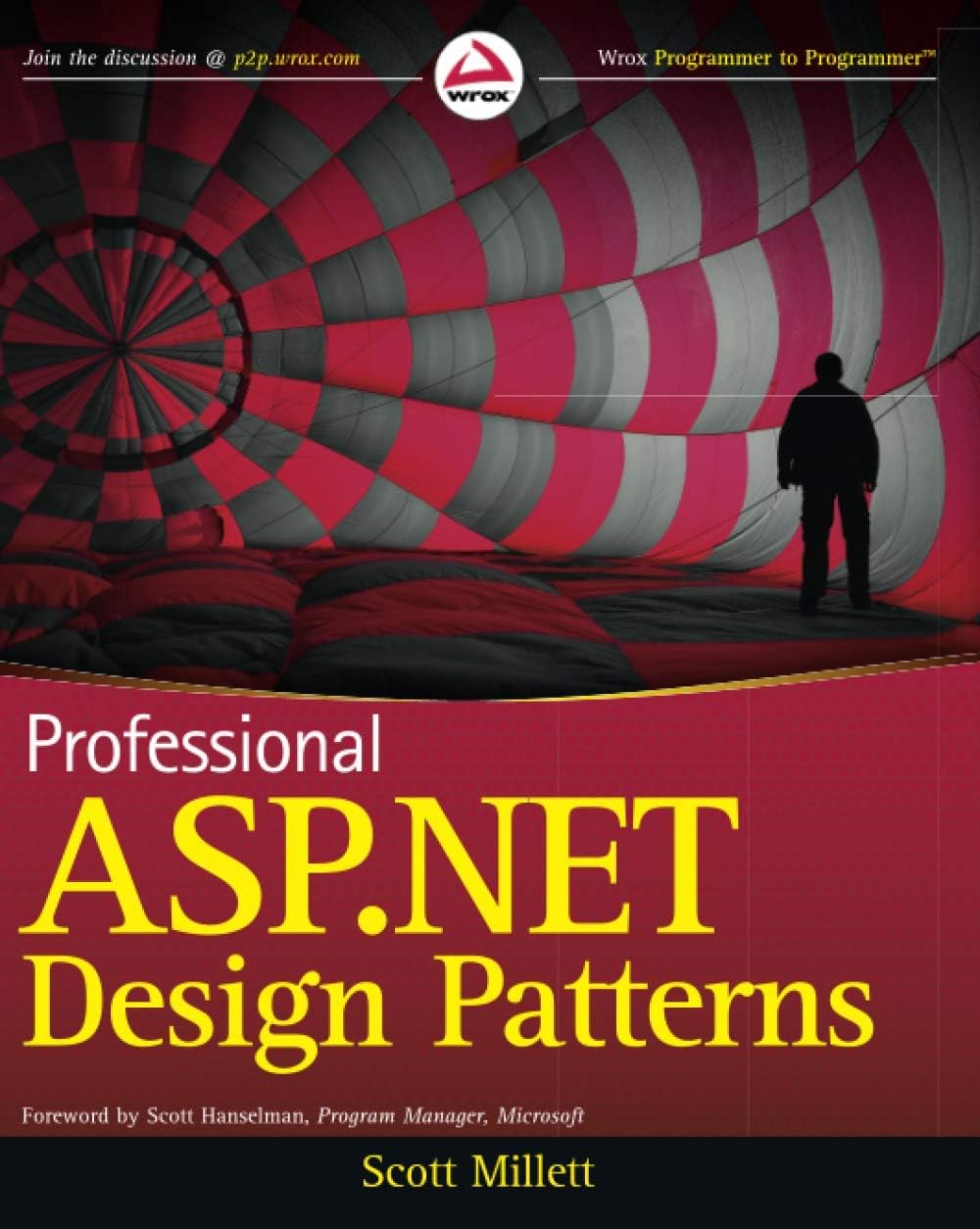
Professional ASP.NET Design Patterns
Product ID: 4651817
Buy anything from 5,000+ international stores. One checkout price. No surprise fees. Join 2M+ shoppers on Desertcart.
Desertcart purchases this item on your behalf and handles shipping, customs, and support to Mongolia.
This unique book takes good ASP.NET (MVC/Webforms) application construction one step further by emphasizing loosely coupled and highly cohesive ASP.NET web application architectural design. Each chapter addresses a layer in an enterprise ASP.NET (MVC/Webforms) application and shows how proven patterns, principles, and best practices can be leveraged to solve problems and improve the design of your code. In addition, a professional-level, end-to-end case study is used to show how to use best practice design patterns and principles in a real website. Professional ASP.NET Design Patterns: All patterns and principles are applicable to ASP.NET MVC and ASP.NET Web forms Demonstrates how to use the Gang of Four design patterns to improve your ASP.NET code Shows how Fowler's Enterprise patterns and the S.O.L.I.D. design principles fit into an enterprise-level ASP.NET site Provides details on how to layer an ASP.NET application and separate your concerns and responsibilities Details AJAX patterns using JQuery and Json, and messaging patterns with WCF Shares best practice tools for ASP.NET such as AutoMapper, NHibernate, StructureMap, Entity Framework, and Castle MonoRail Uncovers tips for separating a site's UX and presentation layer using MVC, MVP and the Front Controller patterns Features code examples that are applicable to all versions of ASP.NET This book features C# code examples in ASP.NET MVC and ASP.NET Web forms. Stay up to date with the latest case study ASP.NET MVC C# code used in the book at the project home page aspnetdesignpatterns.codeplex.com/. Contents: Part 1: Introducing Patterns & Design Principles 1. The Pattern for successful applications 2. Dissecting the Patterns Pattern Part 2: The Anatomy of an ASP.NET Application: Learning and Applying Patterns 3. Layering Your Application 4. Business Logic Layer: Organisation 5. Business Logic Layer: Patterns 6. Service Layer 7. Data Access Layer 8. Presentation Layer 9. User Experience Layer Part 3: Case Study: The Online E-Commerce Store (ASP.NET MVC 2 in C#) 10. Requirements & Infrastructure 11. Product Catalogue Browsing 12. Shopping Basket 13. Membership 14. Ordering and Payment Review: The best software book I have read yet - I am a young professional software engineer, and I have been reading a lot of various software books lately. Coming out of college with a Computer Science degree, I really had no idea how poorly I really understood OO concepts and most of the code I was producing was very procedural in nature. Once I discovered patterns via the Gang of Four book "Design Patterns", I decided it was time to learn some real techniques. Since I was working in an ASP.Net environment, I read some reviews of this book and gave it a shot. I can easily say this is the best book I have read for software engineering yet because I have been able to incorporate so much of what the book offers. This book really has a lot of great patterns that are exactly what I needed to make my development environment more robust. Correctly learning and implementing the multitude of patterns (at each level of the architecture) and learning about various architectural designs has already paid dividends for my systems' stability, testability, and performance. One of the things I like best about this book is that all of the examples are explained very clearly, in great detail. All of the code is downloadable from the WROX site, so I was able to take a hands-on approach to learning the topic. There were a few third-party tools to download (an IoC container, NHibernate, and a mapping tool come to mind), but overall there wasn't much needed other than Visual Studio to start working (of course, all of the necessary dlls were included in the projects from the WROX site, so just using those you wouldn't need to download the third-party tools). I've found that one of the biggest challenges with other books is just getting the environment configured and that wasn't an issue here. It was also good that the author used a multitude of different technologies in the examples. For example, in discussing the implementation of the Repository pattern, ADO.Net, Entities Framework, and NHibernate are all shown as options throughout the book. In discussing the presentation layer, MVP, MVC, and a couple other patterns are discussed, with MVC showing off .Net 4.0's MVC. I would highly recommend this to any professional looking to learn enterprise patterns. Even if you've read the GoF book "Design Patterns", this is excellent because it covers many new patterns that have arisen in the nearly 20 years since that book was first published. Review: Fantastic book, and knowledgeable author - Let me start by saying that while I was reading this book I had many moments where I thought, "he's explained the concept well, but how would you ACTUALLY write the code for that" and then BAM! there's the code example! Really enjoyed this book, it definitely pulls in a lot of concepts, but Scott does a great job explaining how to use various "Gang of Four" design patterns in a REAL application. The early chapters provide a concise summary of the major design patterns, along with some tips and advice on when and how to use them, which I found very helpful. The later chapters Scott walks us through the development of an ASP.NET MVC e-Commerce application, explaining and showing with code how to apply the patterns learned in the earlier parts of the book. I've been developing ASP.NET Web Forms sites for over 5 years, and more recently started doing ASP.NET MVC and I found the book to have just the right tone in terms of introductory concepts and more advanced concepts, without being overwhelming at any point. Personally, I learned a LOT from reading this book, and I have a feeling I'll be re-reading it quite a few more times to fully grasp some of the concepts, and I'll be keeping it handy as a reference as well. I have had conversations with Scott over twitter and I have posted several questions on the Wrox forum, which Scott seems to do a great job monitoring and responding to, which is MUCH APPRECIATED! Bottom line, if you've been doing .NET development for a few years, this book is a MUST HAVE in my opinion. It might be a tad too advanced if you're not familiar with basic OOP principles, but definitely put it on your wishlist :)
| Best Sellers Rank | #5,022,535 in Books ( See Top 100 in Books ) #166 in ASP.NET Programming #198 in Microsoft Access Database Guides #412 in Client-Server Networking Systems |
| Customer Reviews | 4.6 out of 5 stars 70 Reviews |
G**R
The best software book I have read yet
I am a young professional software engineer, and I have been reading a lot of various software books lately. Coming out of college with a Computer Science degree, I really had no idea how poorly I really understood OO concepts and most of the code I was producing was very procedural in nature. Once I discovered patterns via the Gang of Four book "Design Patterns", I decided it was time to learn some real techniques. Since I was working in an ASP.Net environment, I read some reviews of this book and gave it a shot. I can easily say this is the best book I have read for software engineering yet because I have been able to incorporate so much of what the book offers. This book really has a lot of great patterns that are exactly what I needed to make my development environment more robust. Correctly learning and implementing the multitude of patterns (at each level of the architecture) and learning about various architectural designs has already paid dividends for my systems' stability, testability, and performance. One of the things I like best about this book is that all of the examples are explained very clearly, in great detail. All of the code is downloadable from the WROX site, so I was able to take a hands-on approach to learning the topic. There were a few third-party tools to download (an IoC container, NHibernate, and a mapping tool come to mind), but overall there wasn't much needed other than Visual Studio to start working (of course, all of the necessary dlls were included in the projects from the WROX site, so just using those you wouldn't need to download the third-party tools). I've found that one of the biggest challenges with other books is just getting the environment configured and that wasn't an issue here. It was also good that the author used a multitude of different technologies in the examples. For example, in discussing the implementation of the Repository pattern, ADO.Net, Entities Framework, and NHibernate are all shown as options throughout the book. In discussing the presentation layer, MVP, MVC, and a couple other patterns are discussed, with MVC showing off .Net 4.0's MVC. I would highly recommend this to any professional looking to learn enterprise patterns. Even if you've read the GoF book "Design Patterns", this is excellent because it covers many new patterns that have arisen in the nearly 20 years since that book was first published.
K**H
Fantastic book, and knowledgeable author
Let me start by saying that while I was reading this book I had many moments where I thought, "he's explained the concept well, but how would you ACTUALLY write the code for that" and then BAM! there's the code example! Really enjoyed this book, it definitely pulls in a lot of concepts, but Scott does a great job explaining how to use various "Gang of Four" design patterns in a REAL application. The early chapters provide a concise summary of the major design patterns, along with some tips and advice on when and how to use them, which I found very helpful. The later chapters Scott walks us through the development of an ASP.NET MVC e-Commerce application, explaining and showing with code how to apply the patterns learned in the earlier parts of the book. I've been developing ASP.NET Web Forms sites for over 5 years, and more recently started doing ASP.NET MVC and I found the book to have just the right tone in terms of introductory concepts and more advanced concepts, without being overwhelming at any point. Personally, I learned a LOT from reading this book, and I have a feeling I'll be re-reading it quite a few more times to fully grasp some of the concepts, and I'll be keeping it handy as a reference as well. I have had conversations with Scott over twitter and I have posted several questions on the Wrox forum, which Scott seems to do a great job monitoring and responding to, which is MUCH APPRECIATED! Bottom line, if you've been doing .NET development for a few years, this book is a MUST HAVE in my opinion. It might be a tad too advanced if you're not familiar with basic OOP principles, but definitely put it on your wishlist :)
K**I
Great book for senior ASP.NET Developer
Scott did a great job by using examples to show how to design a great flexible, maintainable, and scalable enterprise software. The book serves as a reference point to decide on what design patterns to use in a given situation and introduces the use of NHibernate, StructureMap, AutoMapper.
D**E
Domain Driven Design with real code examples
Although the book was written with examples in an early version of asp.net and a few of them outdated, it doesnt impede on the fact that the book teaches you how to think in domain driven design terms when faced with real life coding decisions. The thing that stands out to me is that there is a c# code example for EVERY design pattern he covers. There is even a final section where you build an ecommerce shop from scratch - again, a couple of parts outdated, but you use the patterns you learnt in the earlier chapters to do so. Probably the most practical book for DDD, programming patterns and c# i have read. If you are interested in applying patterns to your programming, this is still a fantasticaly practical book!
D**B
Great book that ties together difficult concepts with great examples
I've found this the best book yet on Design Patterns. It distills material from many other books, ties together complex concepts, and provides solid examples in c#. This is the first time I've felt I've really "got it", and could now architect applications in the real world leveraging design pattern skills. It also uses a treasure trove of open source tools and frameworks, which is a best practice in itself. It also covers Unit Testing, Mocking, Inversion of Control, Application Layering and Messaging Patterns, as well as providing a practical real-world case study, which is the meat of the concluding third of the book. Highly recommended.
D**D
Code Downloads
If you downloaded the code for the book, there are a few things of which you should be aware. Most of the code was created in VS2008 SP1 (with Framework 3.5) though some later chapters also use VS2010. In addition you need to assure MVC 1.0 is setup for VS2008 in order to run some of the "VS2008" solutions. I had no problems with VS2010 for any of the solutions targeting it. In addition, if there is a "user interface" project in a solution, assure it is the startup project before you run the example. One of the earlier chapters had an incorrect name for one of methods run when the "withdrawal" button is clicked. To correct, go to the code behind select the "Withdraw" method and add "al" to the name of the method. One of the earlier projects had trouble finding the data base filename because a full path was specified for it instead of using the "|Data Directory|" prefix to the mdf file under the App_Data subdirectory. There were at least four places in the solution where the full path was used. You also need to have a local instance of SQLEXPRESS installed and running. I used SQL Server 2008 R2 SQLEXPRESS. For the solutions with unit tests, I installed the latest version of NUnit and set it to run within VS2008 using the External Tools option. If done successfully, "NUnit" should show up under the Tools menu. Click "NUnit" and open the test project assembly you want to run the tests for.
E**K
Most comprehensive book I've every read on Design Patterns
I haven't nothing negative to say about this text. This book is getting old but still has relevance for current development. This book provides excellent foundation for doing professional level development. This is the first text I've read that actually provides a near enterprise level example. There is so much sample code provided it is overwhelming and fantastic. I'm thrilled I found this book and would recommend anyone looking for a good design patterns reference. The examples all do an excellent job of putting the design patterns in context and help to figure out how they are useful and where they fit in application design.
J**N
Good book of examples
I have two projects I inherited with ASP.NET. 1 - MVC & 1 - Webforms. This book offers ideas on working in both environments. The second half builds an e-commerce website in MVC. I did not agree with everything verbatim, but there are not a lot of good ASP.NET books that cover both realms at all and this one is the best I have seen so far.
E**O
Impression réduite...
Très bon bouquin sur les Design Patterns pour ASP.NET ! (+5) Suis-je le seul à avoir un problème d'impression sur chaque page du bouquin: échelle réduite à 75% de la largeur des pages ??? (-1) WROX m'avait habitué à mieux en style d'impression...
A**H
This book is very imp for standard desgin and with ...
This book is very imp for standard desgin and with a mvc project .It is not for beginners but one can if he loves asp.net,OOPS , c#.
L**I
buon libro per i pattern
il libro spiega in modo molto chiaro e semplice, i vari pattern, e con esempi calati su un esempio reale ne mostra l'applicazione. se si ha già un'infarinatura è meglio si fa meno fatica a comprendere.
G**D
exactly what i was hoping for
I've had this book for quite some time now and it definitely deserves a long overdue review. I was looking for something that gave an up to date insight on how real applications are built using some of the most popular and proven patterns. There are too many books around that go head first into one specific way of doing things, and it quickly becomes apparent that you cant apply a lot of the techniques to real world situations. This book is not one of those. Scott provides an introduction to some popular and common design patterns (at which point you will probably find yourself saying 'oh yeah, i used that in '), how they are categorized and most importantly how to read, understand and apply them. He then moves swiftly on to show how these can be used to piece together a rich layered framework on which to build an application. There are various examples of how the various layers interact with each other, all in a very well explained manner, making it easy to understand for developers at any level. I made the mistake of taking this book into the office, and it has been the source of many conversations since. Highly recommended.
K**R
Excellent and clear
As many others have said this book contains good clear introductions to, and examples of the design patterns contained. As anyone who has studied the patterns in theory knows, translating them to the real world is not always as straightforward as one would like and this book does an excellent job of this. It provides lots of good source code, nearly always more than one option e.g. EntityFramework or NHibernate, and good general architecture design.
Trustpilot
3 weeks ago
1 month ago