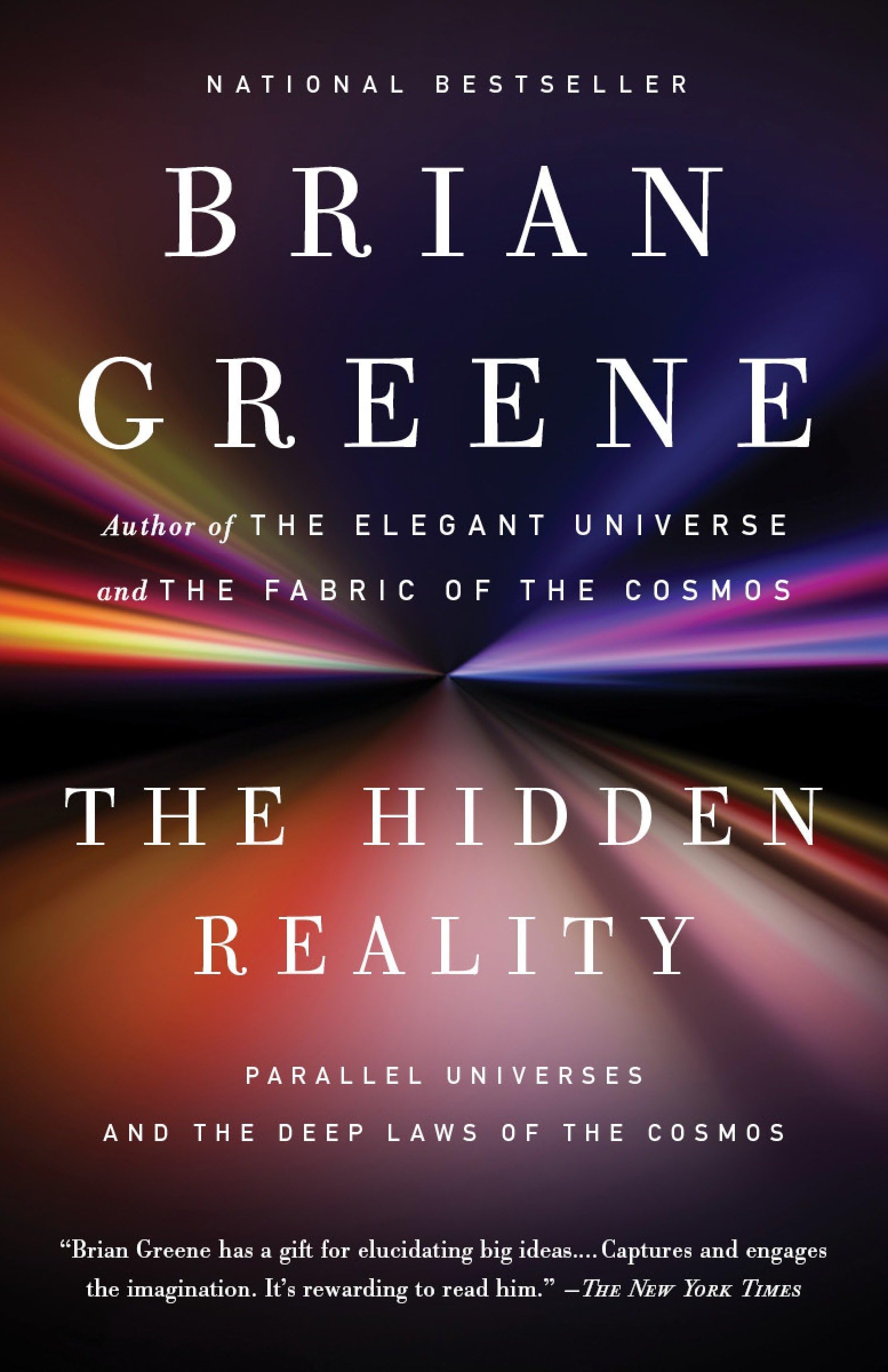
The Hidden Reality: Parallel Universes and the Deep Laws of the Cosmos
Product ID: 5768795
Buy anything from 5,000+ international stores. One checkout price. No surprise fees. Join 2M+ shoppers on Desertcart.
Desertcart purchases this item on your behalf and handles shipping, customs, and support to Mongolia.
The bestselling author of The Elegant Universe and The Fabric of the Cosmos tackles perhaps the most mind-bending question in modern physics and cosmology: Is our universe the only universe? There was a time when "universe" meant all there is. Everything. Yet, a number of theories are converging on the possibility that our universe may be but one among many parallel universes populating a vast multiverse. Here, Briane Greene, one of our foremost physicists and science writers, takes us on a breathtaking journey to a multiverse comprising an endless series of big bangs, a multiverse with duplicates of every one of us, a multiverse populated by vast sheets of spacetime, a multiverse in which all we consider real are holographic illusions, and even a multiverse made purely of math--and reveals the reality hidden within each. Using his trademark wit and precision, Greene presents a thrilling survey of cutting-edge physics and confronts the inevitable question: How can fundamental science progress if great swaths of reality lie beyond our reach? The Hidden Reality is a remarkable adventure through a world more vast and strange than anything we could have imagined. Review: No Road Untraveled. - This challenging, but fascinating, book from Brian Greene is another winner. It turns out that there's not just one version of the multiverse proposal but several, ranging from the Quilted and Inflationary Multiverses to the Brane and Quantum Multiverses. If you'r not careful you could get lost on this mathematical road trip. Drawing on everyday analogues to help explain the various examples of the Multiverse, Greene delves into the mysteries of Quantum Mechanics and Relativity searching for some common ground. As always his writing is geared for the well-read layperson but it helps to have a good background in reading this type of book. If you've read his previous books or similar titles by other authors then this one shouldn't be much of a problem. The whole idea of the Multiverse is based on extreme mathematics but you don't have to be a math wizard to enjoy the book. While the approach is non mathematical Greene does provide some equations (in the notes) for anybody so inclined. Some of the information is given as a kind of "refresher course" in String Theory and Quantum Mechanics but the author gives you the opportunity skip ahead if you wish to. Not being a physicists myself I tend to appreciate that kind of approach. The book is presented in 11 chapters with each chapter devoted to one or two kinds of Multiverse so the reader gets an in depth look at each variety. I found that some chapters were easier to read than others and there were some sections that were a little overwhelming in content. It took me two passes to read The Elegant Universe and three attempts on The Hidden Reality but in the end I got through both of them. I liked the section on the Inflationary Multiverse and it's "Swiss Cheese" analogy, it was the easiest to get through while the section on Quantum Mechanics, Probability Waves and Entropy was the most difficult. A good portion of the book is devoted to the history of theoretical physics and multiverse scenarios, giving you a look at the important people and events that made the most impact. To some people things like String Theory and Multiverses are more of a philosophy than a science since proof of their existence lies beyond our currant technology to access. To that end, the book closes with a section of extreme speculation on the future of computer simulation, artificial intelligence and the Multiverse. Read at your own risk. Scientist the world over are pushing the boundaries of knowledge with mathematics and observations, as well as complicated experiments but, so far, have not been unable to come up with any defining answers. And if the answers are not there or they lead in a different direction, then we will have to come up with a whole new set of metaphors to explain the world around us. The Hidden Reality gives you a well written glimpse at this strange landscape. But keep in mind that neither Greene or anyone else know for certain whether or not there are indeed Multiverses out there and he's the first one to admit that. Theoretical Physics is an active, fast changing field and researchers like Greene will continue probing the fringes of the known universe, looking for a way to combine electromagnetism and gravity into one coherent theory and also looking for the back door into other worlds and universes that may be lurking just out of sight, in some hidden reality. I recommend this book to any science reader who has an open, but skeptical, mind. While I had no technical or formatting problems with this Kindle edition it would have been nice if the publisher had saw fit to include the index, from the hard bound edition, to aid in searching the book. LastRanger Review: Lucid and impressive survey of multiverse models - This is an impressive survey of 9 multiverse models by Greene featured in lucid, engaging and effortless prose. This should be a go to book for the public as well as physics students for a conceptual understanding of the multiverse models available. He began with the "Quilted multiverse" model. This model sets up the most basic bare bone structure of the rationale of multiverse theory. Consider our own visible universe's cosmic horizon of a 14 billion year old universe. The cosmic horizon visible to us is only 41 billion light years (distance based on the light coming from objects receding from us). Our cosmic horizon or patch is all there is ever visible to us. The entire universe in the infinite space can contains infinite number of patches each with it's own cosmic horizon, constituting a quilted universe. Each patch is out of reach of the other patches. This is a basic multiverse model showing each multiverse in its own cosmic horizon patch. The "inflationary model" from Alan Guth and Andrei Linde offers further mechanism to account for how the vast expanse of the multiverse can be built out. The idea is an inflation that is triggered by quantum jitter in high energy inflation field level causing it to expand and bubble out into different multiverses. This inflationary mechanism is also commonly used in other multiverse models. Greene, as a String theorist, offers the String Theory model of multiverse by considering our 3 dimensional expanse universe on a 3-brane sheet. Another multiverse would be on another 3-brane sheet, and there can be as many 3-brane sheets on which each multiverse exists. This multiverse model is the "Brane Multiverse" model. Another String Theory model is the "Landscape" model offered by Suskind. In this model, an inflationary mechanism for bubbling into multiverse is augmented with a further feature of quantum tunneling. A multiverse suffused with higher energy level or cosmological constant can expand via repulsion and inflate, but tunnels or drops down to a lower energy level for bubbling into another multiverse. The multitude of landscape with different cosmological constants represented by unique Calabi Yau manifolds can continue and repeat this tunneling process for proliferating further multiverses. Greene also offers a thorough discussion of the Everttian "multiple-world quantum" model. In this model, the Everttian interpretation of quantum mechanics by branching the possible outcomes of quantum state into different worlds is treated as another multiverse model. Instead of collapsing probability amplitudes as in Copenhagen interpretation, Evertt suggested to let probability outcomes to branch out into different worlds such that each outcome constitute its own world. Greene highlighted that Everttian rationale is that multi-world interpretation actually stays faithful to Schrodinger equation and let the equation results speak for itself instead of ad hoc adding probability amplitudes together which are not reflected in the equation. Greene also discussed if such a multi-world interpretation takes quantum probability seriously, which he thinks each multi-world is still a probabilistic outcome. Another model Greene discussed in this work is the conceptually challenging "Holographic multiverse" model. In this model, our universe is a mere holographic phenomena taking place on a distant bounding surface, a physically equivalent parallel universe. In the holographic principle, open strings movement on 3-branes is described by quantum field particle theory in four dimensional space-time. The physics described is the same as the closed loop strings on 10 dimensional black branes as long as the strings at low energy are closed to the event horizon surface. Hence the holographic model reveals universes as holograms of equivalent parallel universes. Three other models discussed are the Cyclic multiverse model and the mathematical models of "Simulated Multiverse" and "Ultimate Multiverse" models which consider mathematical multiverses to be as real as physical multiverses. There is also a chapter devoted to methodological issues such as experimental accessibility, predictions, and the limits of mathematical applicability to physics.


| Best Sellers Rank | #81,102 in Books ( See Top 100 in Books ) #40 in Cosmology (Books) #43 in Astrophysics & Space Science (Books) #46 in Quantum Theory (Books) |
| Customer Reviews | 4.6 out of 5 stars 1,766 Reviews |
L**R
No Road Untraveled.
This challenging, but fascinating, book from Brian Greene is another winner. It turns out that there's not just one version of the multiverse proposal but several, ranging from the Quilted and Inflationary Multiverses to the Brane and Quantum Multiverses. If you'r not careful you could get lost on this mathematical road trip. Drawing on everyday analogues to help explain the various examples of the Multiverse, Greene delves into the mysteries of Quantum Mechanics and Relativity searching for some common ground. As always his writing is geared for the well-read layperson but it helps to have a good background in reading this type of book. If you've read his previous books or similar titles by other authors then this one shouldn't be much of a problem. The whole idea of the Multiverse is based on extreme mathematics but you don't have to be a math wizard to enjoy the book. While the approach is non mathematical Greene does provide some equations (in the notes) for anybody so inclined. Some of the information is given as a kind of "refresher course" in String Theory and Quantum Mechanics but the author gives you the opportunity skip ahead if you wish to. Not being a physicists myself I tend to appreciate that kind of approach. The book is presented in 11 chapters with each chapter devoted to one or two kinds of Multiverse so the reader gets an in depth look at each variety. I found that some chapters were easier to read than others and there were some sections that were a little overwhelming in content. It took me two passes to read The Elegant Universe and three attempts on The Hidden Reality but in the end I got through both of them. I liked the section on the Inflationary Multiverse and it's "Swiss Cheese" analogy, it was the easiest to get through while the section on Quantum Mechanics, Probability Waves and Entropy was the most difficult. A good portion of the book is devoted to the history of theoretical physics and multiverse scenarios, giving you a look at the important people and events that made the most impact. To some people things like String Theory and Multiverses are more of a philosophy than a science since proof of their existence lies beyond our currant technology to access. To that end, the book closes with a section of extreme speculation on the future of computer simulation, artificial intelligence and the Multiverse. Read at your own risk. Scientist the world over are pushing the boundaries of knowledge with mathematics and observations, as well as complicated experiments but, so far, have not been unable to come up with any defining answers. And if the answers are not there or they lead in a different direction, then we will have to come up with a whole new set of metaphors to explain the world around us. The Hidden Reality gives you a well written glimpse at this strange landscape. But keep in mind that neither Greene or anyone else know for certain whether or not there are indeed Multiverses out there and he's the first one to admit that. Theoretical Physics is an active, fast changing field and researchers like Greene will continue probing the fringes of the known universe, looking for a way to combine electromagnetism and gravity into one coherent theory and also looking for the back door into other worlds and universes that may be lurking just out of sight, in some hidden reality. I recommend this book to any science reader who has an open, but skeptical, mind. While I had no technical or formatting problems with this Kindle edition it would have been nice if the publisher had saw fit to include the index, from the hard bound edition, to aid in searching the book. LastRanger
P**E
Lucid and impressive survey of multiverse models
This is an impressive survey of 9 multiverse models by Greene featured in lucid, engaging and effortless prose. This should be a go to book for the public as well as physics students for a conceptual understanding of the multiverse models available. He began with the "Quilted multiverse" model. This model sets up the most basic bare bone structure of the rationale of multiverse theory. Consider our own visible universe's cosmic horizon of a 14 billion year old universe. The cosmic horizon visible to us is only 41 billion light years (distance based on the light coming from objects receding from us). Our cosmic horizon or patch is all there is ever visible to us. The entire universe in the infinite space can contains infinite number of patches each with it's own cosmic horizon, constituting a quilted universe. Each patch is out of reach of the other patches. This is a basic multiverse model showing each multiverse in its own cosmic horizon patch. The "inflationary model" from Alan Guth and Andrei Linde offers further mechanism to account for how the vast expanse of the multiverse can be built out. The idea is an inflation that is triggered by quantum jitter in high energy inflation field level causing it to expand and bubble out into different multiverses. This inflationary mechanism is also commonly used in other multiverse models. Greene, as a String theorist, offers the String Theory model of multiverse by considering our 3 dimensional expanse universe on a 3-brane sheet. Another multiverse would be on another 3-brane sheet, and there can be as many 3-brane sheets on which each multiverse exists. This multiverse model is the "Brane Multiverse" model. Another String Theory model is the "Landscape" model offered by Suskind. In this model, an inflationary mechanism for bubbling into multiverse is augmented with a further feature of quantum tunneling. A multiverse suffused with higher energy level or cosmological constant can expand via repulsion and inflate, but tunnels or drops down to a lower energy level for bubbling into another multiverse. The multitude of landscape with different cosmological constants represented by unique Calabi Yau manifolds can continue and repeat this tunneling process for proliferating further multiverses. Greene also offers a thorough discussion of the Everttian "multiple-world quantum" model. In this model, the Everttian interpretation of quantum mechanics by branching the possible outcomes of quantum state into different worlds is treated as another multiverse model. Instead of collapsing probability amplitudes as in Copenhagen interpretation, Evertt suggested to let probability outcomes to branch out into different worlds such that each outcome constitute its own world. Greene highlighted that Everttian rationale is that multi-world interpretation actually stays faithful to Schrodinger equation and let the equation results speak for itself instead of ad hoc adding probability amplitudes together which are not reflected in the equation. Greene also discussed if such a multi-world interpretation takes quantum probability seriously, which he thinks each multi-world is still a probabilistic outcome. Another model Greene discussed in this work is the conceptually challenging "Holographic multiverse" model. In this model, our universe is a mere holographic phenomena taking place on a distant bounding surface, a physically equivalent parallel universe. In the holographic principle, open strings movement on 3-branes is described by quantum field particle theory in four dimensional space-time. The physics described is the same as the closed loop strings on 10 dimensional black branes as long as the strings at low energy are closed to the event horizon surface. Hence the holographic model reveals universes as holograms of equivalent parallel universes. Three other models discussed are the Cyclic multiverse model and the mathematical models of "Simulated Multiverse" and "Ultimate Multiverse" models which consider mathematical multiverses to be as real as physical multiverses. There is also a chapter devoted to methodological issues such as experimental accessibility, predictions, and the limits of mathematical applicability to physics.
A**N
A guide through the multiverse possibilities that emerge as consequences of theoretical physics
Brian Greene is truly an excellent science writer. Though there are many ideas that cant be communicated to the lay reader and specifics almost never can, Brian Greene manages to illustrate the general ideas behind what many physicists are thinking and working on and why. The Hidden Reality is an overview of where modern day physics has taken us in terms of the potential nature of reality. In particular he explores the potential initial configurations of the universe and as well the subsequent potential mechanics and what these potentials mean for the nature of reality. He also discusses the nature of reality from the perspective of general relativity, string theory and quantum mechanics. I realize this is vague, but its hard to give a specific overview of what is talked about as the author is almost as concise as he can be to convey the ideas he attempts to. Nonetheless i'll give it a try. The book starts out with the first example of how if we consider our planet and current aggregate configuration and history as unique, then the law of large numbers might cause some alarm in an infinite universe. In particular if we do thought experiment of assuming the universe is truly infinite (spatially with matter in all regions) then it implies that there must be copies of us out there. This results can be deduced from several vantage points and in the book, it is the fact that any negligbly small probability will be hit an infinite number of times if we have an infinite number of experiments. Though the "initial conditions" presented are just a hypothesis, this first chapter sets an eerie start which the book continues to build momentum on. The author then discusses inflationary universes and how they too give rise to multiverse scenarios in which parallel universes will remain unseen as they have inflated at distances that will never be reached. He also discusses what seem to be paradoxes of differing views of infinity, for example, those inside an expanding universe will consider it infinite space with finite time whereas outside they will consider it finite space with infinite time. One gets a glimpse of some of physicists insights but the ideas can be tough and i think to truly understand much of it deeply requires studying the math. The author then gives a brief outline of string theory and gets into the potential multiverse of branes that we might live in (i wont bother to try to paraphrase this part). Subsequent to this the author then introduces what I thought was the first model for parallel universes which is the quantum multiverse in which there is no collapse of the wave function and all possibilities are realized and the wave patterns we see are the parallel worlds interfering. The history of this is given as well as the philosophical misgivings of many scientists. The author then gets into the holographic universe which is pretty hard to grasp, (im pretty sure its hard to grasp even for the expert!) in which our sensations might all be a product of what happens on a lower dimensional space as there is a mathematical mapping between information of a surface with its higher dimensional body. This evolved from some blackhole information theory result... Clearly the book discusses things which are pretty out there but does a good job in trying to communicate what can be communicated to the reader. The book then ventures further into philosophy rather than science and discusses some ideas about what is the "reality" of a computed world and what is the "reality" that mathematical equations exist in. Intertwined throughout the book is the authors discussion of what is science. How much of these interesting ideas about the universe is science rather than philosophy. Much theoretical physics, in particular string theory, has come under a lot of pressure for producing no real testable experiments to its validity (though the experiments being thought up are getting closer to testable) and the author discusses his ideas as to what is legitimate and what is not. The book is primarily on various multiverse possibilities for the universe and how basically all modern theories have multiverse interpretations. Embedded in the writing is also the authors philosophy to legitimize his views on science - he includes some fairly out there theories of computational universes (ie extraordinarily complex simlife type computations) and the multiverse of logically correct statements and equations to show where he draws the line. I pretty much think this is a 5 star book but it is not always consistent. For example, infinity is a complicated issue as there are levels of infinity, integers are countably infinite, the real line is not. In his first chapter, the author argues as to why a multiverse will have a copy of us, he invokes quantum mechanics to legitimize the discreteness of space and thus uses a limiting exercise in the countable sense to get to the conclusion. In the last chapter though he questions this implicitly (but doesnt discuss how it affects his previous arguments) by using the continuum of schrodingers equations values to say we cant escape an infinite configuration space. This is obviously subtle and in aggregate this is a very interesting read in which complicated arguments and phenomenon are well described and the nature of reality and ideas are tackled. I learned a lot and I think everyone can get something out of it.
A**Y
Interesting, but highly controversial
Let me take a swing at a relatively short explanation why some really like this book, while a reasonable minority don't. Really short and rough synopsis of the book. Several independent lines of physics/cosmology have recently indicated that, however the universe we know was formed, the process is likely to have been repeated many times, creating many universes beyond our own. But, they are so far away that Einstein says we can not only not go there, we can't even receive any information from them. This raises a number of interesting questions about the nature of reality, and the nature of science. And the nature of our "uniqueness" on both on a personal and a universal level. Greene tackles most of them head on. Most people find this really hard to wrap their mind around. If there's a very large (infinite?) number of such universes; right now someone just like me is typing this review in many universes. Or typing a different review. Or just blew off the idea of submitting the review off as unproductive. If we can't get information, how is this science? All the above is acknowledged and discussed in the book. Here's the thing. Both calm and heated discussions about all this are now taking place among many very serious scientists in the scientific literature and at scientific conferences. Some at the most sophisticated levels of mathematics. To me, that makes it science. To some, it doesn't. Hence the divide. So, personally I think this truly mind blowing book is Greene's best. Here's one of my favorite bits. Assume that, if we can create a computer that has the same information acquisition and processing power as a human mind, it will be self aware, just like us. We're not that far off from doing it. While we're VERY far off from being able to physically create a Big Bang. It appears that creating a simulated universe in a computer would be far easier than creating a real one. So what's the odds that you and I are in a simulated universe rather than a "real" one? In discussing that, Greene does omit the fact that communications between simulated universes are not ruled out by Einstein. It's not at all surprising that there are very differing opinions about this book. Put me down in the "Greene's best and most interesting book" group.
A**N
Science now tells us we must seriously consider we live in a multiverse
Following up his two previous bestsellers, The Elegant Universe and The Fabric of the Cosmos, Columbia University Professor of Physics and Mathematics Brian Greene has carried on in his attempt to enlighten the lay reader to leading edge developments in scientific research into the deepest mysteries of both the micro-world and the macro-world of not only our own universe, but other universes that may exist beyond our current ability to contact them. Including 30 pages of notes, mostly for the more technically inclined, an extensive index, and using metaphor, analogy, historical anecdotes, and a touch of humour, Professor Greene looks at the latest theoretical thinking and experimental analyses to give, as he says in the Preface, "...a broadly accessible account of some of the strangest and, should they prove correct, most revealing insights of modern physics. Many of the concepts require the reader to abandon comfortable modes of thought and to embrace unanticipated realms of reality." What spurred Greene to give us an up-to-date account of developments in fundamental theoretical physics is that they have led investigators to the serious consideration of different types of parallel universes. In the book, he identifies 9 varieties of what are called "multiverses." And, what is so amazing to Greene and to his colleagues around the world is that "...all of the parallel-universe proposals that we will take seriously (in the book) emerge unbidden from the mathematics of theories developed to explain conventional data and observation." Proceeding like a class in the conceptual, non-technical overview of contemporary physics, displaying his knack for making difficult concepts easy to understand by relating them to common, everyday examples from life, and ascribing nomenclature generally used in the field of cosmology, Dr. Greene first examines what is known as the Quilted Multiverse. He begins the discussion with a review of the Big Bang and Einsteinian relativity to illustrate "...that basic physical principles establish that if the cosmos is infinitely large, it is home to infinitely many parallel worlds - some identical to ours, some differing from ours, many bearing no resemblance to our world at all." Because astronomers have calculated that we can only see out from earth about 41 billion light-years (called the cosmic horizon - an enormous distance, but certainly less than infinite), if the universe itself is infinite, there must be an infinite amount of other regions of space that have their own cosmic horizons. If those regions are sufficiently distant from each other, such an array would look like a patchwork quilt of an infinite number of finite regions that are individual universes themselves. Such a scenario is called a Patchwork or Quilted Multiverse. In such a multiverse, there would be endless doppelgangers - exact, repetitive reproductions of everything we experience, even ourselves. Greene's second type of multiverse is called the Inflationary Multiverse. This one is based on the continual expansion of our universe that would eternally produce bubble universes, and only one of those would be the one we see. We can think of the bubble universes in the Inflationary Multiverse as the holes in an ever-expanding Swiss cheese cosmos. Professor Greene's third and fourth types of multiverses derive from String theory and from the braneworlds of M-theory. In Chapter 4, he reiterates from his previous books a clear explanation of various aspects of quantum mechanics resulting in String theory, extra spatial dimensions, singularities, and black holes that lead us into Chapter 5's discussion of the Brane Multiverse and the Cyclic Multiverse. The former consists of three-dimensional branes (don't worry - Greene explains what branes are) that float in higher dimensions with other branes, and the latter derives from the collisions of those braneworlds that result in new universes with their own big bangs. We are next introduced to something called the Landscape Multiverse. It derives from a combination of the Inflationary Multiverse and String theory. In 1998, two separate teams of astronomers measured a positive but tiny number for Einstein's cosmological constant - a value that gives us the amount of dark, invisible energy thought to be existing uniformly throughout space. Dark energy governs the repulsive gravitational force that drives our universe's inflation. Contrary to what we would expect - that after the Big Bang the inflation of the universe would gradually slow down - the measurements indicated that for approximately the past half of our universe's life its rate of expansion has been accelerating. String theory tells us that each of the ever-increasing number of bubble universes in an Inflationary Multiverse contains a different configuration of extra dimensions "...providing a cosmological framework that realises all possibilities." It also tells us that different values of the cosmological constant in each bubble universe give rise to "...bubbles inside of bubbles inside of bubbles..." When combined with accelerating expansion, this bubble tunnelling process provides an entire "landscape" of different universes. Hence, the totality is called a Landscape Multiverse. 50-page long, Chapter 8 describes what's called the Quantum Multiverse - a multiverse that emerges directly from quantum mechanics. Greene reminds us of the double-slit experiment and its consequential interference pattern in order to guide us through his explanations of a particle's probability wave and Niels Bohr's Copenhagen Interpretation which dictate that the act of measurement/observation results in the collapse of the wave function locating only one position for a given particle - one definite, observed reality outcome. Professor Greene then takes us to the realm of the Holographic Multiverse where reality takes place on a universe's distant boundary surface and projects its information into the 3D world we know and experience as a kind of holographic movie. We can think of this as we would think of the information in an architect's blueprints being translated into the actual physical realisation of a building. In other words, the boundary surface of a universe can be thought of as a physically equivalent parallel universe. Greene adds, "That familiar reality may be mirrored, or perhaps even produced, by phenomena taking place on a faraway, lower-dimensional surface ranks among the most unexpected developments in all of theoretical physics.... Looking to the future, I suspect that the holographic principle will be a beacon for physicists well into the twenty-first century." The 8th and 9th multiverses identified in the book involve both actual and computer simulations. The 8th variety is called a Simulated Multiverse. Here, Greene takes a bold step in contemplating universe creation by future humans in the possession of very advanced technologies. There are two types of these we can think of: (1) usual, physical universes, and (2) virtual, computer-generated universes. The first involves artificially producing a white hole that spews out matter. The second is akin to the conceptual presentation in movies like The Matrix, The Thirteenth Floor, and Vanilla Sky. The 9th and final multiverse discussed is what Professor Greene calls the Ultimate Multiverse. It is his own rationalisation for the existence of a multiverse, independent of being a by-product of quantum mechanics, inflationary cosmology, String theory, or any other such applications that led indirectly to the previous 8 types of multiverses. He surmises, "Maybe math is more than just a description of reality. Maybe math is reality." Perhaps, "Different collections of mathematical equations are different universes. The Ultimate Multiverse is thus the by-product of this perspective on mathematics." (M.I.T.'s Max Tegmark calls this the Mathematical Universe Hypothesis.) Greene further posits, "Mathematical existence is synonymous with physical existence. And since this would be true for any and all math, this provides another road leading us to the Ultimate Multiverse." It's another way of saying that every possible universe we can imagine, and therefore describe with a mathematical equation, is, somewhere and at some time, a real universe. Greene ends with questions like, "Can scientific theories that invoke a multiverse be tested?" And, "Should we believe mathematics?" In fact, he admits that math is central to all he discusses. The multiverse theories examined in his book "rely on a belief that mathematics is tightly stitched into the fabric of reality." He adds in conclusion, "It's only through the rational pursuit of theories, even those that whisk us into strange and unfamiliar domains, that we stand a chance of revealing the expanse of reality." - This review first appeared in New Dawn magazine issue #132
G**G
Every chapter will leave you in somewhat disturbed mental state
This is probably the most readable account on theoretical physics I ever came across. The only one that comes close to it is the old-timer "Physics for Entertainment" by Perelman that was read by all Soviet kids back then. Brian Greene does unbelievable job in crunching and digesting all those otherworldly concepts for regular humans. But don't expect free ride - crunched and digested does not mean easy reading. The book requires intense concentration in certain parts and those parts are many. Those who found strength to finish it will be rewarded by the elusive feeling that they touched (yes, just touched) something incredibly grandiose and remarkable. Those who need more than just touching should consider applying for theoretical physics department somewhere in Stanford or Cambridge. There are several highlights I would like to outline. 1. There is nothing "otherworldly" in probability of existence of parallel universes - it is clear and pure combinatorics applied to infinite (or sufficiently large) space-time. 2. The true gift of being theoretical physicist must be related to the ability to see possible in inversion of well-known phenomena. The notion of repulsive gravity, something I would never dream of, makes sense after few pages of dedicated chapter; right after the author mentions that Gamow paper nobody read for decades. 3. Sometime ago somebody I know attended that show called "Zumanity" in Las Vegas. He told me later that he left the show with very mixed feelings about himself. He could not understand any longer who he is genderwise. Well, nobody warned him that the show was about sexuality. Something similar might happen to those who completed reading the chapter about multiverses created artificially by somebody or something. It will be very unclear after that chapter who we are and why we are here (not to say though it is usually somehow very clear), and, most of all, are we even real? And what does it mean at all to be real? 4. Despite of very clean and logical reasoning, every chapter will leave you in somewhat disturbed mental state.
J**I
Parallel Universes are Interesting but...........
I enjoy reading about parallel and multiverses that come about from some areas in current theoretical research in fundamental physics. I selected this book of the many on the topic of parallel universes since it was written by Brian Greene who is a string theorist and is working on a variety of these topics. He is a person truly gifted with explaining complex topics in physics in ways that make them easier to understand. I have enjoyed his book "The Elegant Universe" on string/M-theory along with the NOVA series DVD's on this book. I also enjoyed his NOVA series DVD's based on his second book "The Fabric of the Cosmos". With this in mind I read The Hidden Reality Parallel Universes and the Deep Laws of the Cosmos. Greene in this book lays out and explains nine different versions of parallel universes. The deep laws are those of quantum mechanics and general relativity. Some physicists would say that string/M-theory which he describes are not deep laws. The explanations of all subjects are as expected clear and supported with an excellent notes section in the back. If you want to learn about parallel universes and the ideas that they come from this is an excellent book to read. That's why the book gets a four star rating. The subtitle says the Parallel Universes and the Deep Laws of the Cosmos. All nine of the parallel universes are based on speculative physics. Some much more speculative than others.That these theories are speculative he admits throughout the book for which he deserves credit. However, in reading this book I got the feeling that this book was the long version of a grant proposal submitted to be funded. This comes about in the numerous places in which he says much has been done but give us more time to work on these ideas. Part of the reason is that some of the parallel universes he describe depend upon string/M-theory which is a controversial topic in physics. This is because in the 30-40 years of its existence, string/M-theories have yet to make any unique predictions that have been observed experimentally in support of these theories. The theory so far is not even falsifiable. Lee Smolin addresses these concerns in his book "Trouble with Physics" as does Peter Woit in his book "Not Even Wrong". The same criticism is also true for the multiverses that come from inflationary. cosmology. However, there are a large number of sharp physicists working in these areas so it is unclear what the future holds. Parallel universe's from Hugh Everett's thesis work on the interpretation of quantum mechanics, now known as the many worlds interpretation is another area of current research in physics and philosophy. This work is based on the measurement problem in quantum mechanics. Greene suggests an experiment in the notes to test this theory, but it is unclear if this has been clearly thought out and if this experiment is even possible. The discussion on computer simulated universes is interesting. It describes a universe similar to that in the movie "The Thirteenth Floor". While not a parallel universe in ways that physics suggests a simulated universe would make the ultimate computer game. A virtual reality that could absorb the programmers life into the simulation. Almost the ultimate drug. Live life to its fullest would have an additional impetus if you live in a simulated universe so that the creator of the simulation would not get bored with you and stop the simulation. However, since you can't prove that you are living in a simulated universe, do you need to live a life to satisfy the simulator? Interesting. The final chapter entitled "The Limits of Inquiry Multiverses and the Future" is well written and makes an interesting conclusion to the book.
Y**S
A non-falsifiable theory of multiverses is not science
I was a fan of Brian Greene's previous books "Elegant Universe" and "Fabric of the Cosmos". About half way through this book I became disappointed and disenchanted. He is moving beyond an exposition of modern physics and becoming more the cheerleader of string theory. I enjoyed first hearing the details of string theory in his Elegant Universe. But as more time passes string theory has nothing more to show for its standing as physics rather than speculation. Also, there is little here you won't find covered in other recent physics popularizations such as Susskind's "Cosmic Landscape". My conclusion is that the attempt of string theorists to postulate infinite universes based on anthropic principles is a last gasp defense of a theory that has over a generation of time to produce scientifically valid results but instead has nothing to show except mathematics divorced from reality. We are asked to accept 10^500 (or more) possible universes with different physical constants and 11-dimensional structures, which of course we won't be verifying by experiment in anyone living's lifetime. This is no longer physics or science, this is science fiction or theology. How much longer should physics be allowed this mathematical speculation to continue? If after 30 years string theory cannot predict anything verifiable in a lab and cannot even define why undetectable infinite multiverses are worthy of being called science, it is time to admit defeat and start over. I'd rather we be discussing angels dancing on the head of pins, at least there isn't a half dozen other books on that subject cluttering up the popular science shelves as there are currently about multiverses. It reminds me of the proof of god arguments that start with imagining a being with perfect qualities. Then the most perfect of beings is one that had all of these properties plus existence. Ergo the most perfect being exists. Well, Mr. Greene, just because you need an infinite number of multiverses to shore up your collapsing theory of strings doesn't make their existence any more real than the existence of a supernatural being. I have one specific mathematical argument to make on this topic. The first of Greene's multiverses is an infinite universe which he insists requires an infinite number of copies of every being who ever lived acting out every action that ever could be acted out. I think there is a logical fallacy in his argument. First, Mr. Greene speculates there may be an infinite size to the universe. Is this universe countably infinite, or an infinity of a higher order? Regardless, I can point to the infinity of real numbers between 0 and 1. I can point to the infinity of rational numbers between 0 and 1. However, the fact that the interval between 0 and 1 contains an infinity of numbers does not allow me to say I will find the number 2 or 5 or pi there. Why should I be convinced that Mr. Greene's infinite universe has infinite copies of me or even an infinite number of planets, or even one, overrun by, say, blue unicorns, within its infinite domain? What if the infinity of planets, suns and galaxies contain only one of us and an infinity of cold dead moons and black holes? On page 186 the author cites the success of modern physics in predicting the magnetic moment of the electron to 12 decimal places. When string theory can calculate that and other physical constants to even one decimal place it will be an accomplishment. But until then string theory and the arguments for an infinity of multiverses seem more and more a desperate attempt to justify a wasted generation of mathematical speculation with no basis in reality. The title "The Hidden Reality" is very apt. String theory's "hidden reality" is no more real than the "hidden" worlds of Valhalla, Hades, Oz or Pepperland. I give Mr. Greene 3 stars only for a well-written book, but I don't wish to read any similar speculative fantasies by him in the future.
A**R
Relativement bon. Haha.
Très agréable à lire, très bonne vulgarisation pour le néophyte que je suis, l'auteur sait se mettre à la portée du lecteur
N**T
The Hidden Reality vs. The 'Unknown' Reality!
(As posted at amazon.com) I learnt (& reconfirmed) a lot about current theories of universe or multiverse from this book and hence, put 5 stars. There are two points I would like to mention after reading this book: (1) Is our existence on the Earth really meaningless, i.e., accidental? (2) Why do we perceive only three dimensions of space, not 4 or 9 or 10? Point (1): It appears that advancements made by modern science in the 20th and 21st centuries have made our existence in this particular corner of the universe increasingly more enigmatic'as if our existence was preordained in a Grand Design; hence comes the first question. Professor Greene explains an answer to the question based on modern science. One idea to make the enigma mundane, statistically, is the idea of multiverse of several theoretical types (albeit existing proponents and detractors of the idea), which may consist of a huge number of universes, and our life-friendly universe is not anything special but merely one of them. Point (2): As we listen to Prof. Greene in the amazon.com video, he explains the possible reasons based on the idea of curled-up dimensions or the extra-dimension connecting the 'braneworlds,' and to experimentally verify the idea, some particle physics experiments are now going on at CERN using the LHC. Physicists are carefully accounting input vs. output energies in the experiments. And if other extra-dimensional models proposed by physicists describe the universe, some small fraction of energy (in the form of gravitons of loop-shaped string) will disappear into the unobservable fifth-dimension (i.e., unobservable to people confined in the four-dimensional spacetime-brane) and we will ultimately conclude the existence of those extra-dimensions. Now, because of my being a non-materialist, may I have an opportunity to refer to some other non-materialistic ideas explaining these two issues? Regarding Point (1): i.e., meaningfulness of our existence on the Earth Just as materialistic science assumes that in the beginning there exist elementary particles or strings materialized from some pure energy, the non-materialistic idea assumes that in the beginning there exists 'unit of consciousness (CU in short)' in some non-physical dimensions; and everything in the physical dimension is the results of the CUs combining each other to form meaningful physical objects, including life on Earth, based on some '(eleven) universal laws,' which transcend our physical laws. So in this idea, existence of life on the Earth is teleological from the start. According to this idea, there will be no meaningless universes; no need to explain 'how come the consciousness out of elementary particles or strings?' Of course need to explain 'how come the CUs?' This non-materialistic idea, i.e., 'psychical knowledge,' so to speak, comes from the book by an American writer, poet, and trance channeler, Jane Roberts (1929-1984): The 'Unknown' Reality, Vols. 1 & 2 (originally published in 1977 & 1979 from Prentice-Hall, now from Amber-Allen). This book is counter to Prof. Greene's The Hidden Reality. Einstein says 'energy and mass are different manifestations of the same thing (i.e., E = Mc^2).' The psychical knowledge says 'consciousness and matter and energy are one, but consciousness initiates the transformation energy into matter.' This is one of the important points of the traditional psychical research, in which an apparently living human form is materialized by a legitimate physical medium. Regarding Point (2): Why do we perceive only three dimensions of space, not 4 or 9 or 10? The psychical knowledge explains to the effect as follows: What we call dimensions represent states in which reality is perceived. We perceive reality in three dimensions, and we have a glimpse of reality in a fourth dimension [e.g., the fourth-dimensional cube known as tesseract]. There are many dimensions however in all directions. [These heavenly bodies represent moment points in other systems. As they are projected into our system however, they are only perceived in terms of matter with our physical senses. The psychical knowledge tells further.] These dimensions merely represent various capacities of consciousness. All these dimensions exist at once, and even within our system, but our consciousness cannot perceive them. (Based on Roberts, J. [1999]. The Early Sessions: Book 6 of the Seth Material: pp. 152−154, Session 258 on May 11, 1966, Manhasset, NY: New Awareness Network) Hence, the reason why we cannot perceive more than three dimensions is because of our consciousness being at such a lower developmental stage! Maybe Emanuel Swedenborg (1688-1772) was at a lot advanced stage of his consciousness, as expressed in his book 'The Earths in the Universe and their Inhabitants (1875).' Because, very probably, there will be criticisms against my posting, saying my writing nonsense, waste of website space, I would like to mention one more point in advance to cope with such possible criticisms. I believe in the weight of soul: the 21 g of missing weight (i.e., unaccountable energy balance) detected by Dr. Duncan MacDougall for his first subject in his experiment published in 1907. Although physics Prof. Robert L. Park states in his book (Superstition: Belief in the Age of Science (2008)) to the effect that the missing weights are the result of MacDougall's wishful thinking and superstitious nonsense, no scientist has ever scientifically either refuted or confirmed the missing weights. Rather, recently a paper was published in the Journal of Scientific Exploration, 2010 Spring Issue (Vol. 24, No.1, pp. 5-39: Rebuttal to Claimed Refutations of Duncan MacDougall's Experiment on Human Weight Change at the Moment of Death. [This Vol.24/No.1 is on sale at amazon.com.]), which supports MacDougall's experiment being scientifically sound on a basis of theoretical simulations of the weighing experiment. The missing weight, if confirmed authentic, is quite relevant to the two points discussed above, because (1) it suggests our life on the Earth being not meaningless, and (2) it suggests existence of non-physical extra-dimensions for afterlife.
Y**A
Fantastico
Fantastico como Greene consigue hacernos entender a todos los conceptos más complejos
A**K
Fascinating look at "our" universe(s)
Brian Greene starts off this book introducing the concept of multiple universes. According to Greene (I'm not a physicist) many, if not most, physics theories lead to some kind of multiple universe solution. They don't all agree on exactly what kind of multiple, parallel, alternate, string, infinite universes exist, but they do suggest that such universes do in fact exist. This forces us to change our concept of universe from everything we could possibly measure to everything that could possibly exist. The book presents eight chapters that focus on explaining different potential multiverses along with two chapters that focus on explaining how we can use math and science to learn about these multiverses and what some limitations might be for our learning about them. Including the introduction, it makes for around 320 pages plus references, but it's actually relatively light reading. Relatively being the key. This isn't "See Spot Run". This is a discussion of the nature of, well, everything. I must admit that I was initially a little disappointed that there isn't an easy, simple solution to the nature of everything. Then I realized that would probably be a little boring and almost certainly wouldn't be true. Fortunately, Greene does a good job making hard topics easy to understand. This is partly due to the fact that complex phenomena must often be reduced to something simpler for even physicists to wrap their heads around them, and partly due to the fact that Greene is very good at making tough concepts easy to get. Most chapters start of with a review of the prerequisite physics for a particular multiverse view. This introduction can be skipped by advanced readers, but more casual science readers (like myself) will find it a very helpful primer or reminder (e.g., of S. Hawking's books). The next part of the chapter delves into the particular theory in question and what kind of universe(s) that theory predicts. The last part of each chapter is more theoretical, asking more complex questions, suggesting future directions, and/or offering extensions of the theory in question. Overall, it makes for good reading as the reader is handily moved from easier to more complicated material. I tend towards biological science reading, but I'd heard such good things about Greene's writing that I thought I'd give this book a shot. I'm glad I did. The only downside is that I now find myself daydreaming about possible universes when I should be thinking about other things. But that's hardly a serious fault for the book. Just the opposite in fact. The idea that there are likely multiple universes, some potentially just like ours, with an exact copy of me typing this exact review or an exact copy of you reading it, is just really, really cool. And that kind of cool is just what good science reading should be all about!
C**N
Great book, truly mindblowing
Get the inside scoop on all things multiverse. Be prepared to work hard and have your own universe expanded.
Trustpilot
4 days ago
2 months ago